ALLWEI Portable Power Station Guide: 300W Models and Family Backup Picks
As Amazon Associates, we earn from qualifying purchases. This means we may receive a small commission at no extra cost to you if you click through and make a purchase.
ALLWEI has carved out a solid reputation in the portable power market by prioritizing long-lasting battery chemistries, practical outlet configurations, and multi-source recharging flexibility. Known primarily for integrating durable Lithium Iron Phosphate cells into accessible form factors, the brand focuses on equipment that handles both casual outdoor recreation and urgent residential backup without complicated setup routines. Their products typically balance pure sine wave inverter safety with responsive battery management systems, giving households dependable off-grid energy for electronics, appliances, and essential medical equipment.
While the company maintains a consistent emphasis on safety and port variety across its catalog, these five featured units diverge significantly in inverter output, energy storage capacity, and targeted use cases, spanning ultra-portable 300W grab-and-go units, complete solar generator bundles, an intermediate 500W emergency power station, and a heavy-duty 2400W expandable home backup powerhouse.
Product rundown
5 models are covered below. Pick a row to jump straight to it.
| No. | Model | Price |
|---|---|---|
| 01 |
 ALLWEI Portable Power Station 300WBest for Lightweight Portability ALLWEI Portable Power Station 300WBest for Lightweight Portability |
Price not listed |
| 02 |
 ALLWEI Portable Power Station 300WBest for Multi-Port Convenience ALLWEI Portable Power Station 300WBest for Multi-Port Convenience |
Price not listed |
| 03 |
 ALLWEI 300W 256Wh Power StationBest for Solar-Ready Camping ALLWEI 300W 256Wh Power StationBest for Solar-Ready Camping |
Price not listed |
| 04 |
 ALLWEI 2400W LiFePO4 Power StationBest for Whole-Home Backup ALLWEI 2400W LiFePO4 Power StationBest for Whole-Home Backup |
Price not listed |
| 05 |
 ALLWEI Portable Power Station 500WBest for Mid-Range Utility ALLWEI Portable Power Station 500WBest for Mid-Range Utility |
Price not listed |
ALLWEI Portable Power Stations Compared
Best for: Home office backup and versatile RV travel
Pros
- 512Wh LiFePO4 pack with 3000 cycles
- 500W pure sine wave inverter with dual AC
- Fast 100W USB-C laptop charging port
- Responsive UPS blackout data protection
Cons
- Heavier 13-pound footprint than 300W models
- Solar recharge requires up to 6.5 hours

Best for: Budget outdoor excursions needing multiple plug points
Pros
- Nine output ports for multi-device charging
- Dual AC outlets on a small frame
- Slightly expanded 280Wh capacity
- Quiet cooling fan operation
Cons
- Standard lithium battery rated for 1500 cycles
- Slower AC wall recharging time

Best for: Weekend camping trips and personal device charging
Pros
- 3000-cycle LiFePO4 battery longevity
- Fast dual charging in under 2.5 hours
- Extremely lightweight at 6.4 pounds
- Versatile 60W USB-C Power Delivery port
Cons
- Single AC outlet limits household versatility
- Not suitable for high-wattage heating appliances
| Model | Capacity | Continuous Output | Battery Chemistry | Key Recharging Options |
|---|---|---|---|---|
| ALLWEI Portable Power Station 300W | 256Wh | 300W (600W Surge) | LiFePO4 | AC Wall, 12V Car, Solar, Dual AC + Solar |
| ALLWEI Portable Power Station 300W (Renewed) | 280Wh | 300W | Lithium | AC Wall, 12V/24V Car, Solar |
| ALLWEI 300W 256Wh Power Station | 256Wh | 300W (600W Surge) | LiFePO4 | AC Wall, Car, 100W Solar (Included), Dual AC + Solar |
| ALLWEI 2400W LiFePO4 Power Station | 2048Wh (Expandable to 10.24kWh) | 2400W (3600W Lifting) | LiFePO4 | 1500W AC, 1200W Solar, Car, Generator |
| ALLWEI Portable Power Station 500W | 512Wh | 500W (1000W Peak) | LiFePO4 | AC Wall (Q Mode), Solar, 12V Car |
ALLWEI Portable Power Station 300WBest for Lightweight Portability
Price not listed
4.2Amazon buyer averageMostly positive
Brand Allwei ASIN B08CXN4TZR
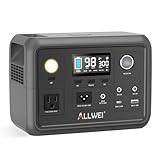
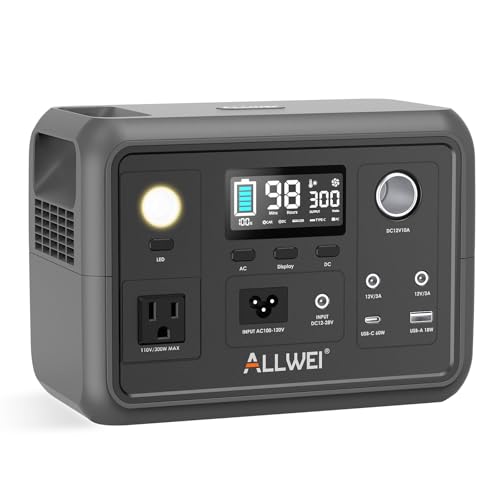
The ALLWEI Portable Power Station 300W serves as an entry point for buyers who need dependable off-grid electricity without bearing significant physical bulk. Engineered around a 256Wh capacity, this unit supplies 300W of continuous power alongside a 600W peak surge rating through a pure sine wave inverter. It measures 9.25 by 5 by 6.81 inches and weighs just 6.4 pounds, making it exceptionally easy to stow in a car trunk, closet, or weekend camping bag. The integrated handle and built-in three-level LED light with SOS mode make it an immediate asset for roadside vehicle troubleshooting or pitch-black storm blackouts.
Longevity stands out as a core strength of this build. Built with premium LiFePO4 battery cells, the station delivers up to 3000 charge-discharge cycles, which equates to nearly a decade of regular use before suffering notable capacity loss. The internal battery management system coordinates a six-layer protection suite guarding against short circuits and temperature spikes. Device connectivity is handled through six simultaneous outputs: one 120V AC outlet, two DC5521 ports, a regulated 12V car cigarette lighter port, an 18W Quick Charge USB-A port, and a versatile 60W USB-C Power Delivery port capable of keeping modern laptops energized.
Recharging adaptability ensures this model stays operational during extended trips away from wall outlets. It accepts AC wall charging in 3.5 to 4 hours, 12V car input in 3.5 to 4 hours, or a 100W solar panel in 4 to 5 hours via its built-in MPPT controller. For rapid turnarounds, users can connect both the wall outlet and solar panel simultaneously to achieve a full replenishment in 2 to 2.5 hours. While shoppers comparing compact options might also evaluate an all powers portable power station, this ALLWEI model stands on its own for families seeking an ultra-compact allwei portable power station 300w with exceptional LiFePO4 cell longevity.
ALLWEI Portable Power Station 300WBest for Multi-Port Convenience
Price not listed
4.1Amazon buyer averageMostly positive
Brand Allwei ASIN B0HBVLKQM4
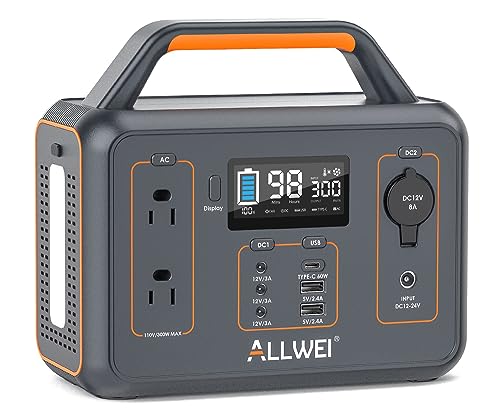
The renewed edition of the ALLWEI Portable Power Station 300W provides an alternative small-format setup that prioritizes port density and energy storage. Offering 280Wh of capacity, this model features a 300W pure sine wave inverter designed to run compact family electronics, camping accessories, and low-draw medical devices like CPAP machines. The unit weighs 6.5 pounds and measures 8.86 by 4.53 by 8.07 inches, retaining the grab-and-go convenience necessary for outdoor excursions, camper vans, and sudden household utility disruptions.
What differentiates this 280Wh version is its generous layout of nine versatile output ports. The front interface provides two 120V AC outlets, three DC 5521 ports delivering 12V at 3A, two USB-A Quick Charge 3.0 ports, a 60W USB-C Power Delivery port, and a standard 12V car socket. An informative LCD display shows real-time system performance and uses flashing icons to alert users to overload, overheating, low voltage, or short circuits. Internally, a silent cooling fan activates under load to regulate operating temperatures without disturbing a peaceful campsite or bedroom environment.
Recharging times for this 280Wh unit vary depending on your energy source. Replenishment via an AC wall outlet takes approximately 5.5 to 6.5 hours, 12V car charging requires 6 to 7 hours, and pairing the station with an external 100W solar panel achieves full capacity in 3 to 4 hours under full sunlight. It relies on standard lithium cells rated for 1500 charge cycles rather than the 3000-cycle LiFePO4 chemistry found on newer siblings. Shoppers prioritizing extra plug points and slightly larger storage will appreciate this setup, though it yields to newer LiFePO4 units in long-term cycle durability.
ALLWEI 300W 256Wh Power StationBest for Solar-Ready Camping

Price not listed
4.0Amazon buyer averageMostly positive
Brand Allwei ASIN B0C9CS3MDJ
Best for: Off-grid campers wanting an included solar panel
Pros
- Includes matching 100W foldable solar panel
- Long-life 256Wh LiFePO4 battery cells
- Rapid 2 to 2.5 hour dual recharging
- Built-in MPPT charge controller
Cons
- Limited to 300W continuous output
- Single AC wall outlet
For individuals seeking an all-in-one solar generating package right out of the box, the ALLWEI 300W 256Wh Power Station bundle eliminates the guesswork of matching solar hardware. This configuration packages the compact 256Wh base station directly with an ALLWEI 100W foldable solar panel equipped with a dedicated DC 5521 connection. Weighing 6.4 pounds and measuring 9.25 by 5 by 6.8 inches, this setup gives car campers, tailgaters, and remote workers a sustainable, renewable charging rig that operates anywhere the sun shines.
The power station delivers a rated 300W continuous output with a 600W surge threshold via its pure sine wave inverter, ensuring safe operation for sensitive devices like laptops, camera batteries, mini-coolers, projectors, and CPAP units. Its six-port array includes one AC outlet, an 18W USB-A quick-charge port, two 5.5 by 2.1 millimeter DC jacks, a 12V vehicle socket, and a high-speed 60W USB-C PD connection designed to recharge phones and mobile computers at more than double the speed of baseline USB ports. An integrated three-level emergency light with SOS signaling is built into the chassis for evening campsite illumination.
The primary advantage of choosing this allwei 300w solar generator package lies in its charging synergy. Thanks to an integrated MPPT controller, the included 100W solar panel can charge the 256Wh battery in 3.5 to 4 hours under direct sunlight. When preparing for trips at home, dual charging using both an AC wall connection and the solar panel slashes recharge times down to just 2 to 2.5 hours. Standard AC wall charging alone takes 3.5 to 4 hours, while car charging takes 3 to 3.5 hours. This bundle represents the best allwei power station for camping families who require off-grid energy replenishment without buying third-party accessories.
ALLWEI 2400W LiFePO4 Power StationBest for Whole-Home Backup

Price not listed
4.3Amazon buyer averageMostly positive
Brand Allwei ASIN B0BTCX6YKJ
Best for: Whole-home emergency backup and heavy appliances
Pros
- Massive 2400W output with 3600W lifting
- Expandable capacity up to 10.24kWh
- Fast 1.5-hour AC wall recharging
- Automated ATS UPS home failover system
Cons
- Substantial weight requires dedicated storage
- Expansion batteries sold separately
When family energy demands shift from small campsite accessories to critical home appliances during extended grid failures, the ALLWEI 2400W LiFePO4 Power Station steps in as a heavy-duty solution. Offering an enormous base capacity of 2048Wh, this machine pairs with a 2400W pure sine wave inverter that features a 3600W power lifting capability. This substantial power threshold allows households to operate demanding appliances including full-sized refrigerators, power tools, electric cookware, space heaters, and sump pumps without triggering overload shutdowns.
Expandability and continuous security define this model. For families facing prolonged winter blackouts, the base 2048Wh capacity can be expanded up to 10240Wh by connecting optional ALLWEI SGR-B200 PRO expansion batteries. It also incorporates an Automatic Transfer Switch (ATS) Uninterruptible Power Supply (UPS) feature. When connected between your wall outlet and vital household hardware, the ATS automatically assumes the electrical load during a blackout without requiring someone to manually press an AC switch. Smart App connectivity allows users to monitor energy levels, switch outputs remotely, adjust charge speeds, and update system firmware over a mobile device.
Despite its massive capacity, the unit features exceptionally rapid input handling. Driven by a 1500W AC wall input, the internal battery reaches 80% in 45 minutes and finishes a complete charge in 1.5 hours using Q Mode. It also accommodates up to 1200W of solar input, as well as car charging, combined AC and solar, or fuel generator charging. Engineered with high-grade LiFePO4 cells offering over 3500 cycles to provide a ten-year operational life, it serves as a formidable domestic backup system for readers who might otherwise compare large units like a coflow portable power station 4800w.
ALLWEI Portable Power Station 500WBest for Mid-Range Utility

Price not listed
4.1Amazon buyer averageMostly positive
Brand Allwei ASIN B0CCNTFDJJ
Striking an optimal middle ground between compact picnic power banks and immovable home backup generators, the ALLWEI Portable Power Station 500W delivers 512Wh of electricity in a convenient 13-pound chassis. Measuring 11.6 by 7.5 by 7.6 inches, this unit is tailored for users who need more continuous wattage and runtime than a 300W model can deliver, but still want something simple to carry between the living room, garage, and vehicle trunk.
At the center of its capability is a 500W pure sine wave inverter with a 1000W engine power maximum, driving dual AC outlets. This allows families to power blenders, larger entertainment systems, and heavy-draw CPAP humidifiers that exceed the thresholds of 300W models. Device charging ports are modern and extensive, featuring a 100W USB-C output for rapid workstation laptop charging, a second 36W USB-C port, two USB-A outlets, two DC5521 jacks, and a standard 12V car outlet. Additionally, the unit incorporates an instant UPS feature to protect desktop computers, modems, and network storage arrays against unexpected data loss when the power grid drops out.
Like its smaller siblings, this allwei lifepo4 generator features robust battery longevity. Its LiFePO4 cells are rated for 3000 charge cycles before dipping to 70% capacity, translating to an estimated ten-year lifespan under typical usage patterns. Replenishing the 512Wh pack takes roughly 2.5 hours via an AC wall socket when operating in Q Mode, while an optional 100W solar panel can restore a full charge in approximately 6.5 hours. It serves as an ideal intermediate investment for shoppers who find 256Wh too limiting for extended power cuts but do not need the footprint of a 2400W station.
How to Choose the Right ALLWEI Portable Power Station
Selecting the ideal ALLWEI unit requires balancing expected energy consumption against physical portability, intended charging conditions, and long-term durability. By analyzing your family’s routine power needs, you can easily determine which allwei power station to buy without paying for excess capacity or underestimating your appliance draw.
- Inverter Output and Appliance Compatibility: The 300W models are designed strictly for low-draw personal electronics, drones, LED lanterns, laptops, and basic CPAP machines. If you intend to operate appliances with moderate heating elements, blenders, or larger audio gear, the 500W model provides the necessary ceiling. For whole-home backup involving refrigerators, kitchen ranges, or power tools, the ALLWEI 2400W LiFePO4 Power Station is required to handle surge demands up to 3600W.
- Battery Capacity and Runtime Expectations: The 256Wh and 280Wh compact stations work well for overnight camping trips or keeping small electronics charged during a 12-hour storm outage. The 512Wh capacity of the 500W model doubles your runtime for home office hardware and small appliances. For multi-day emergency preparedness, the 2048Wh capacity of the 2400W unit—which can expand up to 10.24kWh with external battery modules—ensures household security through extended municipal disruptions.
- Battery Chemistry and Expected Service Life: Four of the five models examined use Lithium Iron Phosphate (LiFePO4) chemistry, rated between 3000 and 3500 cycles for roughly a decade of service. If maximizing lifetime value is your top objective, these LiFePO4 options are superior to traditional lithium chemistries, which generally provide around 1500 cycles before experiencing degradation.
- Specialized Emergency Features: If you plan to safeguard sensitive electronics or medical hardware at home, consider models with integrated UPS or ATS functionality. Both the 500W and 2400W power stations feature automatic failover capabilities, ensuring connected computers and appliances stay running without interruption during sudden utility failures. Shoppers considering broad multi-brand backups can read our echo flow power station guide to assess how automatic switches compare across modern units.
FAQ
Can an ALLWEI 300W power station run a CPAP machine?
Yes, an ALLWEI 300W model can operate most CPAP machines, provided the CPAP draw does not exceed the 300W continuous output limit. To maximize battery runtime from the 256Wh or 280Wh storage capacity, users typically disable the integrated heated humidifier and heated tube, or run the CPAP directly through the DC 12V port if a compatible adapter cable is used.
What is the advantage of LiFePO4 battery chemistry in ALLWEI generators?
LiFePO4, or Lithium Iron Phosphate, offers superior thermal stability, enhanced safety, and significantly longer cycle lives compared to standard lithium-ion batteries. While conventional lithium packs typically degrade after 500 to 1500 charge cycles, ALLWEI LiFePO4 power stations deliver 3000 to 3500 cycles before dropping to 70% or 80% capacity, yielding up to a decade of reliable family utility.
How does the dual charging feature work on ALLWEI 300W models?
Dual charging allows the power station to accept current simultaneously from two separate inputs: a standard AC wall receptacle and an external solar panel. Combining these energy streams significantly cuts down recharging time, taking the 256Wh battery from empty to 100% in approximately 2 to 2.5 hours.
How does the ATS UPS function work on the ALLWEI 2400W unit?
The Automatic Transfer Switch (ATS) Uninterruptible Power Supply (UPS) operates by passing AC power from your wall outlet directly through to your connected household appliances during regular grid operation. If the utility power drops out, the internal inverter instantly assumes the electrical load without requiring a manual switch, keeping essential appliances running continuously even when you are away from home.
Can I recharge an ALLWEI power station while using it to power my devices?
ALLWEI power stations feature pass-through charging managed by their internal Battery Management Systems, allowing users to draw power from the AC, DC, or USB ports while the main battery bank is receiving input from a wall charger, vehicle outlet, or solar panel.
- Ryobi 1800W Power Station Comparison: Reliable Household Power Solutions 4.3Amazon buyer avg
- Anker 24,000mAh Class Power Banks: Heavy-Duty Portable Chargers Compared 4.5Amazon buyer avg
- Westinghouse Tri-Fuel Generators: Complete Home Backup Comparison 4.4Amazon buyer avg
- Hessaire Swamp Coolers Compared: Choosing the Best Model for Your Space 4.0Amazon buyer avg
- EcoFlow Battery Packs: Comparing Standalone Power & Expansion Options 4.4Amazon buyer avg
- Top Generac 5,000-Watt Class Generators Compared for Families 4.0Amazon buyer avg