Bambu Lab Multi-Color 3D Printer Lineup: Which Model Fits Your Home?
As Amazon Associates, we earn from qualifying purchases. This means we may receive a small commission at no extra cost to you if you click through and make a purchase.
Bambu Lab has rapidly established itself as an engineering leader in consumer additive manufacturing, best known for taking complex industrial features like high-acceleration motion, automated bed leveling, and multi-spool material management and putting them into reliable, consumer-ready machines. By automating tedious setup steps and calibration routines, the company has transformed multi-filament production from a finicky technical hobby into an approachable household tool for education, functional repairs, and creative hobby work.
While every model in the manufacturer lineup delivers fast extrusion speeds and plug-and-play network capabilities, these options diverge considerably across their enclosure designs, multi-spool automation limits, active drying technologies, and baseline multi-material readiness.
Product rundown
6 models are covered below. Pick a row to jump straight to it.
| No. | Model | Price |
|---|---|---|
| 01 |
 Bambu Lab P1S ComboBest for Enclosed Multi-Material Utility |
Price not listed |
| 02 |
 Bambu Lab P2S ComboBest for Advanced Intelligent Extrusion |
Price not listed |
| 03 |
 Bambu Lab A1 Mini ComboBest for Quiet Desktop Learning |
Price not listed |
| 04 |
 High-Performance 3D Printer by Bambu LabBest for Demanding Multi-Material Storage |
Price not listed |
| 05 |
 Bambu Lab P2S 3D PrinterBest for Standalone Engineering Speed |
Price not listed |
| 06 |
 Bambu Lab PLA Matte 3D Printer FilamentBest for Clean Surfaces |
Price not listed |
Bambu Lab 3D Printers Compared
| Model | Max Print Speed / Acceleration | Multi-Color Capacity | Chamber Style | Setup & Calibration |
|---|---|---|---|---|
| Bambu Lab P1S Combo | 500 mm/s (20000 mm/s²) | Up to 16 colors (with AMS) | Fully enclosed | Auto bed leveling, 15 min setup |
| Bambu Lab P2S Combo | 600 mm/s (Not listed) | Multi-color via AMS 2 Pro (65 °C drying) | Enclosed, 50 °C chamber, carbon filter | Auto calibration & AI failure detection, 15 min setup |
| Bambu Lab A1 Mini Combo | Not listed (10,000 mm/s² acceleration) | Multi-color via AMS lite | Open frame | Full-auto calibration & active flow compensation, 20 min setup |
| High-Performance 3D Printer by Bambu Lab | Not listed | Up to 24 colors (AMS HT) | Airtight enclosure, 85 °C active air vent | Auto-match drying settings & RFID sync |
| Bambu Lab P2S 3D Printer | 600 mm/s (Not listed) | Single spool native (requires Combo for multi-color) | Enclosed, 50 °C chamber, carbon filter | Auto calibration & AI failure detection, 15 min setup |
| Bambu Lab PLA Matte 3D Printer | Not listed | Single 1 kg spool (RFID AMS auto-read) | Not listed | Embedded RFID parameter configuration |
Bambu Lab P1S ComboBest for Enclosed Multi-Material Utility

Price not listed
8.6/10Our scoreMostly positive
Brand Bambulab ASIN B0CHDS1DMC
Best for: Families printing advanced enclosed multi-color filaments
Pros
- 16-color maximum capacity
- Fully enclosed metal chassis
- High 500 mm/s speed
Cons
- 5-pound heavy chassis
- No internal spool heating
The Bambu Lab P1S Combo pairs a robust enclosed CoreXY printing unit with the standard Automatic Material System to deliver a versatile multi-filament workhorse. Constructed with a black metal body, this setup achieves high velocity with printing speeds rated up to 500 mm/s and acceleration figures reaching 20,000 mm/s². The machine features automated bed leveling right out of the box, ensuring that initial layer deposition remains consistent without requiring manual tension screws or sheet gauges. Setup is straightforward, designed to take roughly 15 minutes before the hardware is ready to lay down its initial lines.
Multi-color production is the core attraction of this bundle. By connecting the included AMS unit, users can feed four spools automatically, with the ecosystem supporting expansion up to 16 colors when additional feeding units are linked. The fully enclosed chassis creates an optimal thermal environment for standard materials like PLA, PETG, TPU, PVA, and PET, while also retaining sufficient ambient heat to reliably process more warp-prone engineering plastics such as ABS, ASA, and capable runs of PA and PC. The listing notes that carbon fiber and glass fiber reinforced polymers are not recommended on this stock setup. Shoppers researching broad capabilities across a wider bambu labs 3d printer collection often consider this package the balanced benchmark for household crafting.
This model is an exceptional fit for parents, educators, and hobbyists who want a secure, enclosed printing zone that keeps drafts out and curious fingers away from moving components. Because it handles ABS and ASA alongside standard craft filaments, it delivers meaningful utility for outdoor hardware and household repair parts. However, users focused exclusively on lightweight decorative prints on open tables may find its 47.5-pound weight and sizeable footprint more than they strictly require.
Bambu Lab P2S ComboBest for Advanced Intelligent Extrusion

Buyer favouriteScored 9.4/10 or higher
Price not listed
9.4/10Our scoreOverwhelmingly positive
Brand Bambulab ASIN B0FT818HCH
Best for: Makers prioritizing high-speed single-filament precision
Pros
- 600 mm/s printing speed
- Adaptive airflow system
- AI failure detection
Cons
- No out-of-the-box multi-color
- Requires combo for multi-spool
Best for: Demanding users wanting smart AI failure checks
Pros
- 600 mm/s high-speed printing
- AMS 2 Pro heated drying
- Active flowrate compensation
Cons
- Large desktop footprint
- Chamber ventilation recommended
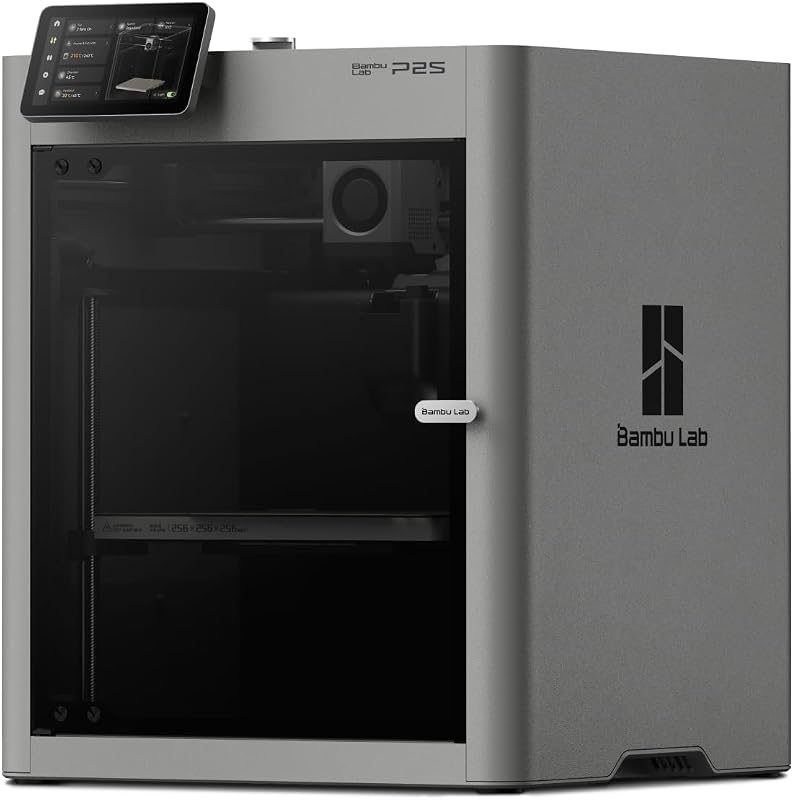
The Bambu Lab P2S Combo represents a notable step forward in automated intelligence and extrusion speed. This grey-finished system increases maximum print velocity up to 600 mm/s, utilizing a PMSM Servo Extruder alongside Active Flowrate Compensation to preserve sharp corners, maintain flat layer lines, and eliminate irregular extrusion seams. Like its predecessor, the package is ready to run within approximately 15 minutes of unpacking, but it layers in advanced hardware perks such as integrated AI failure detection, quick-swap nozzles, and full automatic calibration routines that cut down on manual maintenance.
What sets this combo configuration apart is the inclusion of the AMS 2 Pro module. This updated feeding mechanism facilitates seamless multi-color and multi-material printing while integrating a dedicated filament drying heater capable of reaching 65 °C, ensuring spools stay moisture-free during lengthy runs. Inside the printer, an Adaptive Airflow System regulates cooling fans and heat retention, sustaining a 50 °C chamber temperature for technical thermoplastics while venting safely through an internal carbon filter. Software handling connects cleanly across Bambu Studio, the Bambu Handy mobile app, and the MakerWorld repository, making multi-color project discovery accessible straight from a smartphone or Windows 10 PC. To keep components running smoothly, owners often add specialized tools found in bambu labs accessories kits.
This combo setup is geared directly toward tech-focused families and active creators who produce detailed multi-material toys, mechanical prototypes, or multi-tone artistic models and do not want to worry about stringing or moisture-laden filament ruining long jobs. The built-in drying system and AI error scanning safeguard large builds against waste. Shoppers who do not intend to dry advanced materials or who have strict budget limits can easily find simpler functionality in lighter desktop units.
Bambu Lab A1 Mini ComboBest for Quiet Desktop Learning

Best for: Beginners needing a compact quiet setup
Pros
- Full-auto bed calibration
- 1-clip quick-swap nozzle
- Compact 10 kg build
Cons
- Open frame limits filaments
- Smaller build volume
The Bambu Lab A1 Mini Combo packages multi-filament printing into an accessible, open-format frame tailored for desktop convenience. Operating with a high acceleration rate of 10,000 mm/s², the A1 Mini balances rapid production with a small physical footprint measuring 16.77 inches deep, 14.82 inches wide, and 19.5 inches high. The system is engineered around quiet operation, featuring a simplified color touchscreen interface, pre-assembled structural components that allow first-run calibration in 20 minutes, and a 1-Clip quick swap nozzle assembly that makes clearing jams or switching tip sizes completely tool-free.
Multi-color printing on this machine is driven by the AMS lite, an external four-spool feeder that sits next to or mounts near the printer chassis. The unit incorporates Full-Auto Calibration routines that manage high-precision bed leveling and automated Z-offset measurements without any manual intervention. An integrated active flow rate compensation algorithm dynamically monitors extrusion back-pressure to adjust filament delivery in real time, yielding smooth top surfaces and uniform walls even on complex geometric models. The machine is built around a silver metal frame with a total weight of 10 kilograms, making it portable enough to move between desks or craft rooms.
This compact machine is arguably the best bambu 3d printer for beginners, younger students, and families working within tight home offices. Its quiet stepper motors, approachable interface, and straightforward AMS lite feeding system make it ideal for producing vibrant toys, classroom projects, and decorative desk models. Conversely, its open bed configuration and lack of an enclosed thermal chamber mean it cannot support high-temperature, warp-susceptible engineering materials like ABS or ASA.
High-Performance 3D Printer by Bambu LabBest for Demanding Multi-Material Storage

Price not listed
8.2/10Our scoreMostly positive
Brand Bambulab ASIN B0FK2Y47KR
Best for: Workshops requiring massive 24-color filament feeding
Pros
- Up to 24 colors
- 85 °C high-temp drying
- Brushless servo feeding
Cons
- Narrow technical focus
- Requires compatible host hardware
The listing titled High-Performance 3D Printer by Bambu Lab brings industrial-grade multi-material capability to the desktop through the specialized AMS HT system. Listed as a high-capacity multi-material printing unit, this hardware is engineered to manage up to 24 colors simultaneously across multiple connected banks. Constructed from durable PC and PA components, the unit incorporates a brushless servo motor that guarantees smooth, reliable feeding across extended tubing runs, minimizing mechanical resistance and eliminating skipped steps during multi-spool swaps.
Drying performance is a major highlight of this high-capacity unit. It features an electro-magnetic air vent mechanism paired with an 85 °C high-temperature active drying chamber that actively removes ambient humidity from engineering spools. An automated rotating mechanism ensures that filament heats evenly across the entire spool rather than developing brittle hot spots. For delicate or specialized stocks, an independent bypass material outlet routes soft, flexible, or brittle materials directly to the extruder without subjecting them to sharp internal feeding bends. The unit also houses an integrated RFID sensor to synchronize material data and auto-match drying profiles for official Bambu filaments, operating cleanly with STL and OBJ files over PC and laptop interfaces.
This dedicated hardware suits demanding technical makers, home laboratories, and advanced hobbyists who regularly run moisture-sensitive nylon, structural polycarbonates, or complex 24-color designs requiring continuous spool switching. Its high-heat drying chamber and heavy-duty motor drive make it unmatched for material conditioning. However, everyday household creators printing casual PLA models will find this level of temperature capacity and multi-channel hardware far beyond their routine demands.
Bambu Lab P2S 3D PrinterBest for Standalone Engineering Speed

Price not listed
8.0/10Our scoreMostly positive
Brand Bambulab ASIN B0FT7ZLSSC
The Bambu Lab P2S 3D Printer is the standalone version of the P2S platform, delivered without the external AMS multi-material feeding unit. Operating at speeds up to 600 mm/s, this machine utilizes the same PMSM Servo Extruder and Active Flowrate Compensation found on the Combo variant to output clean, dimensionally accurate physical parts. The printer measures 18 inches deep, 21 inches wide, and 18 inches high, weighing in at 38.9 pounds within a fully enclosed grey cabinet designed for straightforward desktop placement.
This base unit incorporates full automated calibration, AI-assisted print failure monitoring, and a quick-swap nozzle assembly that gets users running within 15 minutes of unboxing. It features the brand’s Adaptive Airflow System, which balances cooling for crisp bridging while maintaining an internal 50 °C chamber temperature suited for demanding filaments. An activated carbon air filter cleans internal exhaust, while software integration links seamlessly with MakerWorld models via the Bambu Handy smartphone application and Windows 10 network slicers. It is important to note that the product listing explicitly clarifies that this standalone P2S 3D printer does not support multi-color printing on its own; a compatible AMS Combo setup is required to unlock multi-spool functionality.
This configuration is ideal for functional hobbyists, home handymen, and technical users whose primary goal is fabricating durable, single-color replacement brackets, tools, and structural enclosures using high-performance filaments. It delivers the chamber heat, speed, and safety filtering of a high-end CoreXY machine while leaving the multi-material expansion open for the future. Shoppers seeking multi-color prints out of the box will need to opt directly for the Combo version instead.
Bambu Lab PLA Matte 3D Printer FilamentBest for Clean Surfaces

Buyer favouriteScored 9.4/10 or higher
Price not listed
9.4/10Our scoreOverwhelmingly positive
Brand Bambulab ASIN B0CDGRWS27
Best for: Creators wanting clean glare-free finished surfaces
Pros
- RFID automated AMS sync
- Non-glare matte appearance
- Eco-friendly reusable spool
Cons
- Single filament spool only
- Restricted to 1.75 mm systems
The Bambu Lab PLA Matte 3D Printer spool is an essential consumable engineered to maximize the visual quality of multi-material builds. Supplied in Scarlet Red as a 1 kg spool, this 1.75 mm polylactic acid filament features a precise dimensional tolerance of +/- 0.03 mm. The matte formulation yields a non-glossy, anti-glare finish that hides layer lines and softens surface textures, giving finished architectural models, tabletop figurines, and decorative items an understated, high-end appearance.
Usability is streamlined through built-in automation. The spool contains an integrated RFID chip that instantly communicates optimal nozzle temperatures, bed heating parameters, and extrusion rates directly to the Bambu AMS unit upon loading. This eliminates manual parameter guesswork in slicing software and reduces print failures from incorrect thermal settings. The material exhibits high tenacity and reliable layer adhesion without clogging, bubbling, or tangling. Furthermore, the spool itself is reusable, allowing makers to buy refill cores that reduce plastic packaging waste by 20 percent. For shoppers comparing sheen and durability across different spools, reading a guide to bambu lab pla filament selections can help match the right texture to the project.
This matte material is specifically designed for creators running Bambu multi-color systems who want rich, glare-free colors that present beautifully on display. Its integrated RFID tracking makes it especially practical for busy households where kids or beginners might otherwise load incorrect slicing temperatures. Users seeking flexible rubber-like parts or outdoor heat resistance beyond PLA thresholds should look toward technical polymers instead.
How to Choose the Right Bambu Lab 3D Printers
Selecting the best Bambu multi-color hardware configuration for your household comes down to assessing the types of materials you want to melt, your available tabletop footprint, and how much automated assistance you desire. Because the Bambu Lab ecosystem spans both open-frame desktop machines and fully enclosed CoreXY systems, establishing your primary use case early prevents you from either overbuying hardware or running into thermal limitations.
- Enclosed vs. Open-Air Workspaces: If you plan to fabricate functional household components using temperature-sensitive materials like ABS, ASA, or polycarbonates, an enclosed model like the Bambu Lab P1S Combo or Bambu Lab P2S Combo is vital. The enclosed chamber retains internal heat and shields the print bed from room drafts that cause corners to peel and warp. Conversely, if your creative projects revolve around decorative toys, organizers, and student assignments printed in PLA or PETG, the open-frame Bambu Lab A1 Mini Combo delivers rapid speeds and exceptional detail without the bulk or weight of a full cabinet.
- Multi-Color Spool Capacity: Multi-material flexibility depends on which material system you pair with the printer. The compact AMS lite included with the A1 Mini Combo handles four active spools in an open configuration. The standard AMS system paired with the P1S can be networked up to 16 spools for complex chromatic models, while the high-capacity AMS HT setup expands material management up to an astounding 24 colors with heavy-duty servo feeding for industrial workflows.
- Filament Drying and Moisture Management: Moisture in filament causes stringing, sputtering, and weakened layer bonds. The Bambu Lab P2S Combo addresses this issue directly by incorporating 65 °C active spool heating in its AMS 2 Pro module, while the specialized AMS HT hardware provides high-temperature 85 °C active drying. Standard AMS units offer sealed storage with desiccant compartments, which works well for PLA and PETG but requires pre-dried spools for hygroscopic materials.
- Automation and Error Prevention: Families balancing busy schedules benefit immensely from automated safeguards. While the P1S Combo provides reliable automatic bed leveling and straightforward operation, the newer P2S line adds AI failure detection to catch spaghetti failures early, active flow rate compensation for crisp corners, and quick-swap nozzles that simplify tip maintenance to a matter of seconds.
FAQ
What makes a bambu 3d printer multi color system different from traditional printers?
Traditional multi-color printing often required complex multi-extruder hardware, awkward manual filament pauses, or third-party splicing boxes that jammed frequently. Bambu multi-color systems integrate automatic material switching directly into the machine firmware and slicing software. The AMS units smoothly retract the active filament, cut it at the toolhead, feed the new color, purge the transition zone, and continue printing without requiring any manual user intervention during the build.
Can the base Bambu Lab P2S 3D printer print multi-color prints without accessories?
No, the standalone Bambu Lab P2S 3D printer listing explicitly confirms that it does not support multi-color printing on its own. The base unit includes only a single spool feed pathway. To produce multi-color prints on the P2S platform, you must either purchase the Bambu Lab P2S Combo bundle or later add a compatible AMS unit to manage automated filament switching.
How does bambu ams multi color printing handle filament changes during a build?
During a layer change requiring a new shade, the toolhead moves to a designated purge chute at the rear of the build plate. An internal lever cuts the previous filament, and the AMS motorized rollers retract the remaining strand back into its spool holder. The system then feeds the next spool down the PTFE tubing into the hotend, extrudes a small purge tower to clear old pigment, verifies flow using internal sensors, and resumes laying down the new color on your model.
Which bambu lab 3d printer to buy for a beginner or family setting?
For young creators, students, and beginners looking for an approachable introduction to 3D printing, the Bambu Lab A1 Mini Combo is widely considered the best bambu 3d printer for beginners. It features a simplified touchscreen, whisper-quiet motor operation, a safe low-voltage bed, and full-auto calibration that sets Z-offset and leveling without manual tuning. Families wanting to tackle larger mechanical repairs and technical filaments in a secure enclosed box should step up to the Bambu Lab P1S Combo.
Do Bambu Lab printers require proprietary filament to work properly?
No, Bambu Lab 3D printers feature an open filament architecture, allowing you to use any standard 1.75 mm spool from third-party manufacturers. However, using genuine Bambu spools provides a significant convenience advantage because their integrated RFID tags allow the AMS unit to instantly detect the material type, color, and optimal printing temperatures without requiring any manual data entry in your slicing software.
- Fluke Screwdriver Set Guide: Choosing Safe, Durable Tools for Household Repairs 8.6/10Our score
- OlarHike Portable Tire Inflator Guide: Choosing the Right Compressor for Your Family Vehicle 8.6/10Our score
- Gorilla Outdoor Glue Comparison: Durability and Ease of Use for Household Fixes 9.4/10Our score
- Shark Hair Styling Tool Guide: Comparing Multi-Stylers and Dryers for Everyday Use 8.0/10Our score
- Top DeWalt 18V Bare Power Tools Compared for Durability and Value 8.0/10Our score
- Milwaukee Cordless Impact Drivers: Choosing Reliable Value for Your Home Workshop 9.4/10Our score