Comparing the Top Filament Dryer Solutions for Bambu Lab Printers
As Amazon Associates, we earn from qualifying purchases. This means we may receive a small commission at no extra cost to you if you click through and make a purchase.
Bambu Lab has earned a sterling reputation among 3D printing enthusiasts for high-speed precision and seamless multi-material switching, yet keeping filament dry inside the stock Automatic Material System remains a challenge for busy households. Because the standard enclosure relies on passive desiccant packs rather than active heating elements, ambient moisture can gradually infiltrate open spools during extended printing sessions, leading to stringing, rough layer surfaces, and failed prints. Investing in an active bambu lab filament dryer upgrade transforms the stock storage box into an active dehumidifying station, ensuring consistent extrusion without requiring external standalone dry boxes.
While each option in this lineup provides active drying for bambu lab ams setups, they differ significantly in their internal architecture, ranging from uniform single-zone heated covers that warm four spools simultaneously to sophisticated multi-chamber designs featuring independent heat zones and automated moisture exhaust vents.
Product rundown
4 models are covered below. Pick a row to jump straight to it.
| No. | Model | Price |
|---|---|---|
| 01 |
 SUNLU AMS HeaterBest for Straightforward Lid Replacement |
Price not listed |
| 02 |
 SUNLU AMS HeaterBest for Stackable Multi-Unit Setups |
Price not listed |
| 03 |
 SUNLU Filament DryerBest for Automated Sensor Control |
Price not listed |
| 04 |
 【EIBOS Official】 3D Printer Filament DryerBest for Independent Multi-Spool Drying |
Price not listed |
Bambu Lab Filament Dryers Compared
| Model | Capacity | Max Temperature | Heating Architecture | Chamber Isolation |
|---|---|---|---|---|
| SUNLU AMS Heater (SLMX-AH-US-GMSLUS) | 4 Spools | 70°C | Directed Airflow PTC | Single Shared Chamber |
| SUNLU AMS Heater (DCUS-AH-US) | 4 Spools | 70°C | PTC with Metal-Roller Fan | Single Shared Chamber |
| SUNLU Filament Dryer (AMS) | 4 Spools | 70°C | Dual-Airflow Fast PTC | Single Shared Chamber |
| 【EIBOS Official】 3D Printer Filament Dryer | 4 Spools | 65°C | Forced-Air with Auto-Venting | 4 Independent Chambers |
SUNLU AMS HeaterBest for Straightforward Lid Replacement

Price not listed
9.0/10Our scoreVery positive
Brand Sunlu ASIN B0FLP97HMW Prime eligible
Best for: Space-saving stacked printer workshops
Pros
- Stackable flat-top lid design
- Triple-safe PTC heating system
- Integrated metal-roller circulation fan
- Smart humidity monitoring
Cons
- Shared heating across all spools
- Not compatible with AMS Gen 2
Best for: Budget-conscious family 3D printer setups
Pros
- Reaches 70°C in 20 minutes
- Non-destructive 3-step lid installation
- Dedicated motor thermal shielding
- Includes installation tool and hardware
Cons
- Uniform single-zone heating
- Incompatible with AMS Gen 2
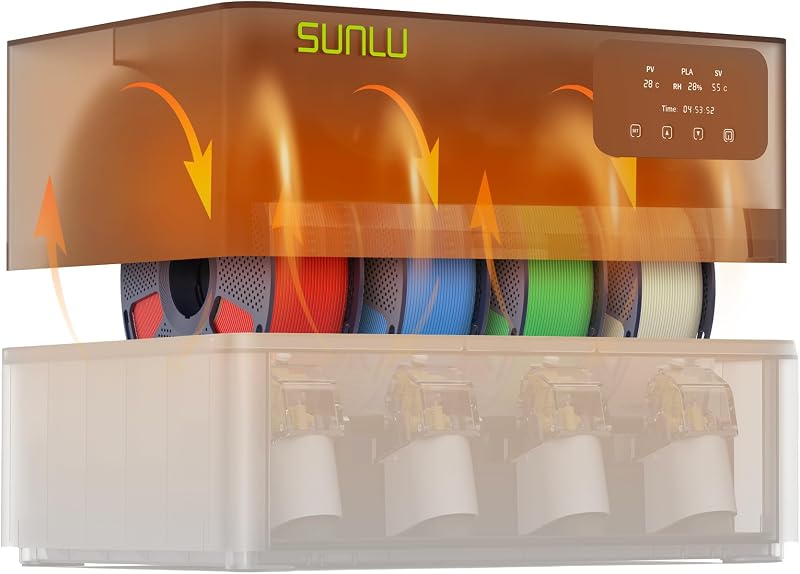
The SUNLU AMS Heater is an active thermal heating lid designed specifically to upgrade the first-generation Bambu Lab Automatic Material System. For family makers frequently printing household replacement parts, school projects, or toys using bambu lab pla filament, moisture accumulation can cause invisible damage that results in brittleness and rough print textures. This add-on directly replaces the factory AMS lid, allowing users to actively dry up to four spools of 1.75 mm filament while printing continues uninterrupted. Because it works as a drop-in replacement, it maintains full mechanical compatibility with the automated feeding and multi-color switching systems of the AMS Gen 1 unit.
Thermal delivery is powered by a high-efficiency heating system capable of reaching 70°C (158°F) in just 20 minutes, accelerating moisture evaporation across common consumer thermoplastics. A common concern with retrofitting heating elements onto automated feed units is the vulnerability of delicate feeder motors to thermal damage. To mitigate this, the unit integrates a specialized internal airflow design that concentrates heated air exclusively around the spool reels while isolating the motorized mechanical components below. Installation is non-destructive and requires just three steps using the included hexagonal screwdriver, eight hexagonal screws, four hinges, and dedicated power cord, ensuring the original housing remains unmodified.
This model is an excellent match for home hobbyists who want a dependable, hassle-free bambu lab ams dryer upgrade without drilling or complex wiring. It operates as a unified single-zone dryer, meaning every spool in the bay receives the same heat cycle. While perfect for uniform material setups, users handling materials with vastly divergent thermal limits at the same time will find this model yields to independent multi-chamber configurations.
SUNLU AMS HeaterBest for Stackable Multi-Unit Setups

Price not listed
8.8/10Our scoreVery positive
Brand Sunlu ASIN B0GGZ5HNP6 Prime eligible
Finished in an inky black shell, this edition of the SUNLU AMS Heater targets workshops and hobby spaces that require active drying while maintaining an organized, space-efficient footprint. Keeping moisture out of hygroscopic filaments like bambu lab petg filament is vital for clear, bubble-free layer adhesion. This unit acts as a direct top-cover swap for the AMS Gen 1, actively heating four spools simultaneously while preserving multi-color feed capabilities and sealed environmental storage. A standout structural feature of this model is its reinforced flat-top profile, which allows makers to stack multiple units or workspace accessories directly on top to conserve desktop area.
Safety engineering is reinforced through a triple-safe thermal management assembly. The unit incorporates a positive temperature coefficient (PTC) heating element, a high-durability metal-roller circulation fan, secondary thermal cutoff switches, and intelligent software monitoring. This architecture reaches 70°C within 20 minutes, distributing warmth evenly while proprietary internal ductwork channels heat away from the AMS drive motors. Furthermore, built-in smart humidity control tracks ambient conditions within the enclosure to maintain an optimal moisture-free environment throughout lengthy print jobs, all without requiring permanent shell modifications or drilling.
Family workshops running frequent multi-day prints will appreciate the heavy-duty components and stackable convenience of this heater lid. Its four-spool capacity ensures uninterrupted workflow across expansive multi-color designs. However, because it shares a single heating chamber across all four roll bays, it requires users to load filaments with matching temperature tolerances during any given drying cycle.
SUNLU Filament DryerBest for Automated Sensor Control

Price not listed
8.6/10Our scoreMostly positive
Brand Kunphy ASIN B0FQVHHBQV Prime eligible
Best for: Hands-off automated humidity control
Pros
- Auto-start and stop humidity sensor
- Tool-free 2-minute cover swap
- Dual-airflow rapid PTC heating
- Lightweight ABS construction
Cons
- Lacks individual spool chambers
- Limited to AMS Gen 1
Distributed under the Kunphy label, the SUNLU Filament Dryer focuses on automated climate control to eliminate stringing, nozzle popping, and weak structural boundaries caused by damp spools. Built from resilient acrylonitrile butadiene styrene (ABS) and weighing 3.7 pounds, this lid replacement upgrades the Bambu Lab AMS 1.0 into an active dehumidifier that dries four spools simultaneously while the printer operates. By maintaining low internal humidity, it helps users achieve smoother exterior walls and superior layer lamination across long fabrication sessions.
The heating core utilizes an accelerated PTC element paired with a dual-airflow distribution system, allowing the internal chamber to achieve its 70°C target in approximately 20 minutes. This dual-circulation pattern prevents stagnant hot spots and ensures even drying across standard materials including PLA, PETG, and ABS. What sets this model apart is its automated humidity sensing routine: the sensor continuously monitors moisture levels, starting the heating process automatically when dampness rises and shutting it down once the filament is properly dry. Installation is completely tool-free, taking roughly two minutes to swap the original AMS top shell while retaining all original feeding mechanics.
This system is ideal for casual hobbyists and family makers seeking an intuitive, set-and-forget drying setup that manages its own duty cycles. For anyone deciding which bambu lab filament dryer to buy to avoid manual timer checks, this unit delivers seamless operation. Its main limitation remains its single-zone architecture, which heats all four rolls uniformly rather than isolating individual spools.
【EIBOS Official】 3D Printer Filament DryerBest for Independent Multi-Spool Drying
Buyer favouriteScored 9.4/10 or higher
Price not listed
9.4/10Our scoreOverwhelmingly positive
Brand Eibos ASIN B0GJ5KL5BH
Best for: Advanced multi-material printing enthusiasts
Pros
- 4 independent drying chambers
- Automatic motorized moisture exhaust venting
- Adjustable 20°C to 65°C individual controls
- Second-stage thermal preheating process
Cons
- Heavier 8.8-pound overall footprint
- Max temperature capped at 65°C
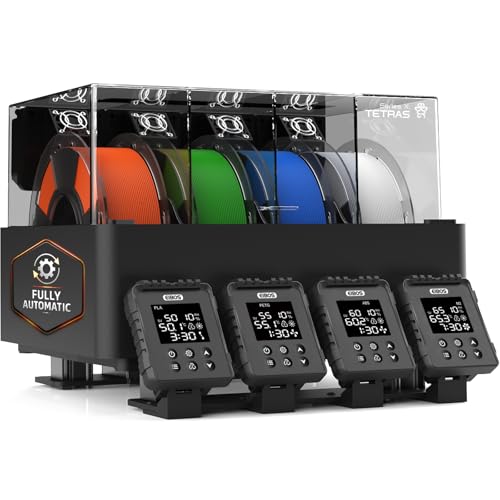
The 【EIBOS Official】 3D Printer Filament Dryer, commonly known as the Tetras, introduces professional multi-zone thermal engineering to the Bambu Lab AMS Gen 1 platform. While standard heater covers treat the entire spool bay as one large communal chamber, the EIBOS Tetras filament dryer partitions the bay into four completely independent drying compartments. Each individual spool slot is outfitted with its own dedicated heater, circulation fan, digital interface, and combined temperature and humidity sensor. This configuration allows makers to dry vastly different filament types—such as PLA, PETG, ABS, TPU, and Nylon—side by side without cross-temperature interference.
Each independent bay features precise digital thermal control ranging from 20°C to 65°C, with operational timers adjustable from 30 minutes up to 24 hours, alongside an unlimited continuous drying mode. The Tetras operates via its own dedicated power supply, eliminating any additional electrical burden on the printer itself. Moisture removal is actively managed through forced-air circulation across the heating coils and spool surfaces, paired with motorized exhaust covers that automatically raise to vent humid air out of each chamber. Once drying is complete, the chambers automatically seal, and an intelligent Humidity Mode reactivates heating if ambient moisture creeps back in. A second-stage thermal sequence provides high-efficiency drying followed by stable preheating, ensuring reliable feeding with flexible filaments.
Constructed from durable ABS with a sturdy 8.8-pound total weight, this bambu lab multi spool dryer is the definitive pick for advanced creators, technical makers, and family workshops working with mixed material types. It stands as the best filament dryer for bambu lab ams users who demand individualized temperature and ventilation profiles for every reel. Its trade-offs include a slightly heavier desktop footprint and a 65°C top temperature, which is slightly below the 70°C ceiling found on single-zone PTC covers.
How to Choose the Right Bambu Lab Filament Dryer
Selecting the ideal dryer add-on depends largely on the materials your family prints most frequently, your workshop space constraints, and how much hands-on control you prefer over temperature cycles. Conducting a thoughtful bambu lab filament dryer comparison helps ensure your drying hardware complements your printing habits without adding unnecessary complexity.
For households printing predominantly with everyday materials like PLA and PETG, single-zone lid replacements like the standard and stackable SUNLU heaters provide the most practical balance of thermal speed and physical simplicity. Reaching 70°C in just 20 minutes, these units circulate hot air uniformly across four spools while printing continues in real time. Their non-destructive, drop-in replacement designs make them easy to install within minutes using basic hand tools, preserving stock feeding mechanics while introducing active thermal dehumidification.
If you regularly run diverse filaments simultaneously—such as pairing rigid structural parts with flexible accents or technical materials like Nylon—individual chamber control becomes essential. The EIBOS Tetras separates the AMS bay into four distinct climate zones, allowing you to tailor precise heat and timer settings for each spool slot. Its automatic exhaust vents actively evacuate moisture rather than trapping humidity inside, making it an exceptional choice for advanced engineering projects.
Automation and safety features should also guide your decision. Units equipped with integrated humidity sensors can initiate heating cycles automatically when moisture rises, which helps maintain consistent drying without constant user intervention. Regardless of the model you select, verifying that the unit incorporates isolated airflow ductwork to shield the AMS feeder motors from excessive heat is crucial for long-term equipment reliability. Evaluating your filament collection alongside testing standard bambulab filament pla materials will help clarify whether a streamlined single-zone cover or an advanced multi-chamber system best serves your home workshop.
FAQ
Can I print and dry filament at the same time with these upgrades?
Yes, all the featured dryer units are specifically engineered to dry spools actively while the printer is running. Because they replace the upper lid of the AMS while leaving the lower feeding rollers, PTFE paths, and electronics intact, the filament feeds directly into the toolhead while remaining warm and dry throughout the entire print job.
Will installing an active dryer damage the AMS feeder motors?
The models in this lineup incorporate specialized airflow routing designed specifically to safeguard sensitive drive components. By directing heated air upward and around the spool bays while restricting thermal flow toward the lower motor compartment, these units prevent excessive heat buildup around the feeding drive mechanisms.
Are these filament dryer lids compatible with the Bambu Lab AMS Gen 2?
The listings explicitly specify compatibility with the Bambu Lab AMS Gen 1 (also referred to as AMS 1.0). The manufacturers note that these heater lids are not compatible with second-generation AMS hardware due to dimensional and mechanical variations in the enclosure design.
Why does the EIBOS Tetras max out at 65°C while single-zone lids reach 70°C?
Single-zone lids utilize high-output PTC heating elements paired with wide-duct circulation fans to heat the entire shared cavity to 70°C. The EIBOS Tetras relies on four smaller, completely isolated heating chambers with motorized exhaust flaps and localized sensors. Its 65°C limit is calibrated to deliver safe, sustained multi-material drying across its partitioned bays without risking heat creep between adjacent slots.
Do I need tools to install these Bambu Lab dryer upgrades?
Installation requirements vary slightly between models, but all are non-destructive drop-in upgrades. The standard SUNLU heater includes a dedicated hexagonal screwdriver, hinges, and screws for a simple three-step hinge swap, while other configurations feature tool-free snap-in top replacements. None of the models require permanent cutting, drilling, or structural alterations to the factory AMS base.
- Midea Dual Hose Portable Air Conditioners Compared for Family Value 8.6/10Our score
- Giraffe Tools Wall-Mounted Pressure Washer Comparison: Choosing the Right Setup for Your Garage 8.4/10Our score
- Lysol Toilet Bowl Cleaner Hydrogen Peroxide Formulas Compared for Family Homes 8.4/10Our score
- EGO Power+ Pressure Washer Lineup: Which Model Fits Your Home? 9.2/10Our score
- Ryobi Bucket Vacuums Compared: Choosing the Best Fit for Home and Workshop 8.6/10Our score
- Gain Laundry Detergent Sheets and Pacs: Complete Brand Guide 9.8/10Our score