Hisense 50-Pint Dehumidifier Comparison: Which Model Fits Your Home?
As Amazon Associates, we earn from qualifying purchases. This means we may receive a small commission at no extra cost to you if you click through and make a purchase.
Hisense has earned a solid reputation in home climate appliances by focusing on dependable moisture removal, straightforward mechanical layouts, and efficient energy consumption. For households managing persistently damp basements, humid laundry rooms, or muggy living areas, the brand delivers practical dehumidification hardware capable of running smoothly even in lower ambient temperatures down to 38°F. Their engineering emphasizes functional durability over unnecessary gimmicks, incorporating washable filtration screens, clear water-level monitoring, and robust compressors designed to protect residential building materials and maintain indoor comfort.
While each unit in this lineup is built around reliable moisture management, the models differ substantially in their drainage configurations, bucket access designs, daily extraction capacities, and footprint dimensions to address distinct household demands.
Product rundown
5 models are covered below. Pick a row to jump straight to it.
| No. | Model | Price |
|---|---|---|
| 01 |
 Hisense 50-Pint Lift-Up Portable DehumidifierBest for Overhead Drainage Hisense 50-Pint Lift-Up Portable DehumidifierBest for Overhead Drainage |
Price not listed |
| 02 |
 Hisense 50-Pint Portable Dehumidifier. 4500 Sq.Best for Manual Bucket Drainage Hisense 50-Pint Portable Dehumidifier. 4500 Sq.Best for Manual Bucket Drainage |
Price not listed |
| 03 |
 Hisense 50-Pint Lift-Up Portable DehumidifierBest for Easy Bucket Access Hisense 50-Pint Lift-Up Portable DehumidifierBest for Easy Bucket Access |
Price not listed |
| 04 |
 Hisense 50 Pint Dehumidifier 300 sq.Best for Compact Living Zones Hisense 50 Pint Dehumidifier 300 sq.Best for Compact Living Zones |
Price not listed |
| 05 |
 Hisense 35-Pint Compact DehumidifierBest for Mid-Sized Living Areas Hisense 35-Pint Compact DehumidifierBest for Mid-Sized Living Areas |
Price not listed |
Hisense Dehumidifiers Compared
| Model | Daily Extraction | Drainage Method | Coverage Area | Weight |
|---|---|---|---|---|
| Hisense 50-Pint Lift-Up Portable Dehumidifier (Black) | 50 pints | Built-in pump and quick-connect hose | 4,500 sq ft | 40.3 pounds |
| Hisense 50-Pint Portable Dehumidifier. 4500 Sq. | 50 pints | Manual collection bucket and gravity drain | 4,500 sq ft | 38.8 pounds |
| Hisense 50-Pint Lift-Up Portable Dehumidifier (White) | 50 pints | Built-in pump with 18-pint top-lift bucket | 4,500 sq ft | 20.2 pounds |
| Hisense 50 Pint Dehumidifier 300 sq. (DH5023KP) | 50 pints | Built-in pump and slide-out bucket | 300 sq ft | 40.0 pounds |
| Hisense 35-Pint Compact Dehumidifier | 35 pints | Slide-out collection bucket | 3,000 sq ft | 32.6 pounds |
Hisense 50-Pint Lift-Up Portable DehumidifierBest for Overhead Drainage

Price not listed
4.0Amazon buyer averageMostly positive
Brand Hisense ASIN B0GWFVLJF3

Best for: Effortless bucket emptying and quiet living spaces
Pros
- Top-lift 18-pint bucket
- Integrated pump with hose
- Lightweight 20.2-pound body
- Easy-roll casters
Cons
- Squat footprint takes floor area
- 18-pint tank requires frequent emptying
Best for: Basements needing continuous upward pump drainage
Pros
- Built-in pump with hose
- 4,500 sq ft coverage
- Low-temperature 38°F operation
- ENERGY STAR certified
Cons
- 3-pound chassis
- Requires floor clearance
The Hisense 50-Pint Lift-Up Portable Dehumidifier in black is engineered specifically for demanding residential moisture extraction across expansive layouts up to 4,500 square feet. It pulls up to 50 pints of moisture per day from ambient air, making it an effective line of defense against mold development, wood rot, and clammy indoor air. Built with a sleek dark casing measuring 10.7 inches deep, 15.1 inches wide, and 24.8 inches high, this residential unit fits neatly against perimeter walls while handling severe humidity loads across wide subterranean rooms or open floor plans.
The standout utility of this machine lies in its active discharge hardware. Equipped with an integrated discharge pump and an included quick-connect hose, the unit can elevate wastewater upward into a sink basin or ground-level basement egress window without requiring manual intervention. Operating flexibility is further enhanced by three operational modes—Auto, Continuous, and Manual—alongside three distinct fan speeds (High, Low, and Auto) that let you tune acoustic output against immediate drying performance. An ENERGY STAR certification helps moderate electricity consumption during extended runs, while low-temperature functionality keeps the compressor cycle operating smoothly down to 38°F in chilly subterranean utility spaces.
This model is ideal for property owners who need sustained, hands-off operation in basements lacking a low-level floor drain. If you want continuous water evacuation routed upward without lifting heavy water reservoirs every single day, this unit provides that mechanical pumping muscle. However, if your utility room already features an accessible floor drain and you do not require mechanical lifting pressure, you may prefer a simpler gravity-draining alternative.
Hisense 50-Pint Portable Dehumidifier. 4500 Sq.Best for Manual Bucket Drainage

Price not listed
4.2Amazon buyer averageMostly positive
Brand Hisense ASIN B0GWFN8LQR
Best for: Homes using manual bucket gravity drainage
Pros
- 4,500 sq ft moisture removal
- ENERGY STAR certified
- Clear bucket-full indicator
- Three fan speeds
Cons
- No internal pump
- Manual bucket emptying
The Hisense 50-Pint Portable Dehumidifier. 4500 Sq. offers high-capacity extraction inside a traditional white chassis for broad residential spaces up to 4,500 square feet. Generating 50 pints of daily extraction, it matches the moisture removal capacity of premium units while utilizing standard reservoir containment and gravity drainage pathways. Those exploring different brand layouts might also compare this configuration against our overview of the tcl dehumidifier 50 pint alternative to see how baseline reservoir setups compare across manufacturers.
Control remains precise thanks to three dedicated operational modes: Auto mode dynamically adjusts run time according to detected ambient humidity, Continuous mode runs non-stop for urgent drying needs, and Manual mode allows users to set target humidity levels manually. The unit incorporates a responsive bucket-full indicator to prevent messy spills, alongside a visible water level window on the reservoir face. Its three fan speeds permit quiet operation during sleeping hours or high airflow when drying must occur quickly, and low-temperature engineering allows operation in chilly spaces down to 38°F without the internal coil frosting over.
This model is specifically tailored for households where a floor drain is readily available for standard gravity hose evacuation, or for homeowners comfortable with manually dumping the collection reservoir. By omitting an active internal pump, it offers straightforward reliability with fewer mechanical parts to manage. Families looking for effortless, upward water routing to an elevated utility sink, however, will want to look at the pump-equipped variants instead.
Hisense 50-Pint Lift-Up Portable DehumidifierBest for Easy Bucket Access

Price not listed
4.1Amazon buyer averageMostly positive
Brand Hisense ASIN B0GWFQCYRW
The Hisense 50-Pint Lift-Up Portable Dehumidifier in white pairs high-capacity extraction with an ergonomic top-access architectural design. Removing up to 50 pints of daily moisture across spaces reaching 4,500 square feet, this model rethinks physical maintenance by placing its generous 18-pint internal tank directly beneath a top-lift housing. Weighing just 20.2 pounds and measuring 11 inches deep, 16.9 inches wide, and 19 inches high, it provides high-capacity moisture control in a noticeably lighter, more compact profile than traditional upright towers.
In addition to its ergonomic tank placement, this model integrates an internal pump and includes a quick-connect drain hose that can push collected water out through a window or into an elevated sink basin for continuous, unattended dehumidification. Mobility across hardwood and tile floors is made smooth via four easy-roll caster wheels, allowing you to reposition the appliance between living rooms and damp crawlspaces effortlessly. A washable, removable air filter traps airborne particulate before it settles on the condenser fins, ensuring cleaner airflow and maintaining peak mechanical efficiency season after season.
This unit is best for individuals who want versatile water disposal options without straining their backs during bucket maintenance. The top-lift 18-pint reservoir avoids the awkward stooping required by traditional low-mounted slide-out buckets, while the active pump accommodates hands-free upward drainage. For shoppers evaluating similar active pumping designs from competing product lines, our guide on the frigidaire dehumidifier with pump provides helpful context on how different internal pumps handle vertical head pressure.
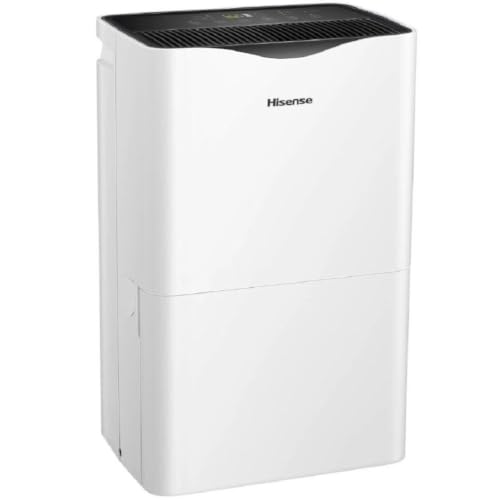
Hisense 50 Pint Dehumidifier 300 sq.Best for Compact Living Zones
Price not listed
4.4Amazon buyer averageVery positive
Brand Hisense ASIN B0CZ7PYZSC
Best for: Compact basements requiring low noise and pump
Pros
- Integrated pump drainage
- Quiet 48 dB operation
- Slide-out bucket with handle
- Low-temperature 38°F run
Cons
- Amazon Renewed model
- Listing notes 300 sq ft
The Hisense 50 Pint Dehumidifier 300 sq. (model DH5023KP, renewed) brings high-rate moisture extraction into concentrated residential quarters. While the product listing title highlights capacity ratings up to 4,500 square feet, its specifications and description focus heavily on rapidly remediating humidity in concentrated rooms up to 300 square feet, such as enclosed workshops, laundry suites, or damp garage bays. Built with a durable white plastic cabinet weighing 40 pounds, it offers rugged construction designed to handle demanding everyday utility environments.
Equipped with an integrated pump, this model allows water to be pumped upward and outward without relying solely on downward gravitational slope. For households that prefer manual collection, the slide-out bucket includes an integrated easy-carry handle that prevents water from sloshing when walking to the sink, supported by an auto shut-off mechanism to avert overflow. Operational acoustic levels are kept low at 48 dB, allowing the machine to dehumidify home offices or bedrooms without creating harsh background chatter, while 38°F low-temperature capability prevents coil icing in unheated outbuildings.
This model suits homeowners who need the heavy-duty water extraction of a 50-pint rating combined with an internal pump, but intend to focus that power inside smaller, problem-prone rooms. Its integrated handle makes short-distance moving straightforward, while the slide-out bucket design provides a familiar, mess-free emptying routine. If you need brand-new factory packaging rather than renewed hardware, however, the standard retail Hisense 50-pint models are a better fit.
Hisense 35-Pint Compact DehumidifierBest for Mid-Sized Living Areas

Price not listed
4.0Amazon buyer averageMostly positive
Brand Hisense ASIN B0GWFQFXV5
Best for: Mid-sized spaces needing compact efficiency
Pros
- Compact 32.6-pound frame
- ENERGY STAR certified
- Two-year warranty
- Slide-out bucket handle
Cons
- 35-pint daily limit
- No built-in pump
The Hisense 35-Pint Compact Dehumidifier is scaled for smaller residences, apartments, and mid-sized zones where a full-sized 50-pint unit would be excessive. Capable of removing up to 35 pints of moisture per day across areas up to 3,000 square feet (with listing materials noting coverage up to 3,500 square feet), this unit delivers balanced humidity regulation inside an unobtrusive cabinet measuring 9.4 inches deep, 13.8 inches wide, and 19.7 inches high, weighing a manageable 32.6 pounds.
Daily maintenance is kept simple through a front slide-out bucket system featuring an auto shut-off float switch that terminates operation the moment liquid capacity is reached. A molded easy-carry handle allows quick transport between rooms, while low-temperature operation down to 38°F lets it run dependably in unheated garages, three-season porches, and chilly basements. It carries ENERGY STAR certification to ensure electricity consumption remains minimal over long seasonal cycles, backed by a two-year manufacturer warranty that underscores its durable internal componentry.
This compact unit is ideal for apartment dwellers, condominium owners, or homeowners addressing localized humidity in bedrooms, dens, and crawl spaces. It provides dependable climate protection without occupying excessive square footage. If you are comparing mid-sized units against whole-house installations, reading our overview of frigidaire dehumidifiers for home use can offer broader perspective on sizing appliances properly for family spaces.
How to Choose the Right Hisense Dehumidifier
Choosing the best moisture management system requires matching extraction capacity to your square footage, evaluating physical drainage mechanics, and reviewing room layout requirements. When reviewing this lineup, identifying your daily moisture volume is the foundational step. The 50-pint models are engineered to tackle up to 4,500 square feet of severe dampness, making them the standard choice for full basements, flooded utility spaces, and whole-home air treatment. In contrast, the 35-pint unit is better optimized for spaces up to 3,000 square feet, providing effective regulation for single floors, attached workshops, or apartments without drawing unneeded power.
Drainage accessibility is the next critical factor when deciding which unit to purchase. Models featuring an internal discharge pump—such as the black 50-pint lift-up unit, the white top-lift 50-pint machine, and the DH5023KP—allow upward liquid transfer through an included hose directly out a basement window or into a high utility sink basin. If your placement area lacks an active pump requirement because a floor drain is nearby, a standard gravity-drained unit like the Hisense 50-Pint Portable Dehumidifier 4500 Sq. provides reliable moisture removal without the extra mechanical complexity of a pump motor.
Physical maintenance ergonomics should also shape your selection. Traditional slide-out buckets require bending down to floor level and carefully sliding out a heavy water basin, which can present spill risks on finished floors. Hisense addresses this on the white lift-up model by implementing a top-lift 18-pint reservoir, letting users lift the container straight out from waist height. For households relying on manual dumping rather than continuous hose lines, an ergonomic bucket design with a sturdy carrying handle significantly reduces daily maintenance strain.
Finally, factor in operational acoustics and ambient climate limitations. All five models evaluated here are rated for low-temperature operation down to 38°F, preventing freeze-up in cool basements during transitional spring and autumn seasons. If acoustic disturbance is a major consideration for living rooms or bedrooms, look closely at units offering dedicated low-fan settings and lower decibel profiles, such as the 48 dB rating on the DH5023KP. Balancing these environmental factors will ensure you select an appliance that protects your home structure while operating seamlessly alongside your family routine.
FAQ
How does the built-in pump work on a Hisense dehumidifier?
The built-in pump collects condensate inside an internal sump before activating a small mechanical motor that propels the water through a quick-connect hose. Unlike gravity drainage systems that require the discharge hose to slope downward toward a floor drain, an active pump creates sufficient pressure to push water vertically upward into an elevated sink, laundry tub, or basement window egress, enabling fully unattended continuous operation.
Can Hisense dehumidifiers run safely in unheated basements?
Yes, the Hisense dehumidifiers in this guide feature low-temperature operation ratings down to 38°F. Standard room dehumidifiers frequently suffer from frozen evaporator coils when ambient temperatures drop below 60°F, but these units are engineered to cycle their refrigeration systems effectively in cool basements, crawlspaces, and detached garages without ice build-up crippling performance.
What is the difference between Auto, Continuous, and Manual modes?
Auto mode relies on the internal humidistat to monitor surrounding air, turning the compressor on and off automatically to maintain a balanced humidity target while saving electricity. Continuous mode bypasses relative humidity targets to run the refrigeration cycle uninterrupted, which is ideal for drying damp masonry or recovering from indoor water intrusion. Manual mode gives the user full control over specific humidity targets and fan speeds to suit personal preferences.
How often do I need to clean the air filter?
Hisense dehumidifiers feature washable, removable filters designed to trap dust, hair, and airborne particulate before they coat internal condenser fins. Under regular seasonal operation, you should inspect and rinse the filter with cool water every two to four weeks. Ensuring the filter remains clear prevents airflow restriction, reduces compressor strain, and helps the unit operate at peak energy efficiency.
What are the benefits of a top-lift bucket design over a slide-out bucket?
A top-lift design repositions the water reservoir so it can be lifted upward directly from the top section of the machine rather than sliding out from the bottom base. This eliminates the need to bend or stoop to floor level, minimizes accidental water splashing across finished flooring, and provides an easier carrying grip when transporting water to a sink or drain.
- The Complete Resolve Carpet Cleaner Comparison for Family Homes 4.4Amazon buyer avg
- Shark Vacuum Mop Roundup: Which Model Fits Your Daily Cleaning Routine? 4.4Amazon buyer avg
- DEWALT Propane Heater Comparison: Finding the Right Jobsite Heat 4.2Amazon buyer avg
- The Best eufy Robot Vacuums for Busy Households Compared 4.6Amazon buyer avg
- The Ultimate Shark Upright Vacuum Comparison for Family Homes 4.8Amazon buyer avg
- Which eufy Wet Dry Vacuum Is Best for Busy Family Homes? 4.9Amazon buyer avg