Callsun Solar Panels: Comparing N-Type Models for Dependable Off-Grid Power
As Amazon Associates, we earn from qualifying purchases. This means we may receive a small commission at no extra cost to you if you click through and make a purchase.
Callsun has established a distinct reputation in the off-grid solar space by engineering photovoltaic modules centered on cutting-edge N-type monocrystalline silicon and dense 16-busbar collector networks. Unlike traditional solar manufacturers that rely on older P-type cell architectures, the brand focuses on delivering panels with higher baseline efficiency ratings, superior resistance to light-induced degradation, and low temperature coefficients that preserve energy output in scorching summer weather. For family campers, recreational vehicle owners, and cabin builders, these engineering choices translate into more amp-hours harvested from limited roof surfaces, durable mechanical construction that withstands heavy wind and snow loads, and dependable performance over decades of outdoor exposure.
Across this lineup of callsun solar panels, each model differs primarily in overall wattage delivery, individual panel dimensions, working voltage characteristics, and whether the design utilizes a solid opaque backsheet or a transparent bifacial surface that captures reflected sunlight from behind. Understanding these distinctions helps determine which callsun solar panel to buy for a specific off-grid battery configuration or vehicle footprint.
Product rundown
4 models are covered below. Pick a row to jump straight to it.
| No. | Model | Price |
|---|---|---|
| 01 |
 N-Type 16BB 400W Bifacial Solar PanelBest for Portable Power Stations N-Type 16BB 400W Bifacial Solar PanelBest for Portable Power Stations |
Price not listed |
| 02 |
 420W(2x210W) N-Type 16BB Bifacial Solar Panel,VmpBest for Higher-Voltage Solar Banks 420W(2x210W) N-Type 16BB Bifacial Solar Panel,VmpBest for Higher-Voltage Solar Banks |
Price not listed |
| 03 |
 N-Type 16BB 200 Watt Solar PanelBest for Compact Rooftop Layouts N-Type 16BB 200 Watt Solar PanelBest for Compact Rooftop Layouts |
Price not listed |
| 04 |
 N-Type 16BB 200W Bifacial Solar PanelBest for Streamlined Single-Panel Builds N-Type 16BB 200W Bifacial Solar PanelBest for Streamlined Single-Panel Builds |
Price not listed |
Callsun Solar Panels Compared
| Model | Total Rated Power | Dimensions & Weight | Operating Voltage (Vmp) | Cell Architecture |
|---|---|---|---|---|
| N-Type 16BB 400W Bifacial Solar Panel | 400 watts (2 x 200W) | 51.3 x 30.3 x 1.4 in, 23.8 lbs each | 23.74 V (47.48 V Series) | N-Type 16BB Bifacial, TwinCell Parallel |
| 420W(2x210W) N-Type 16BB Bifacial Solar Panel,Vmp | 420 watts (2 x 210W) | 54.2 x 30.2 x 1.4 in, 24.9 lbs each | 34.2 V Each | N-Type 16BB Bifacial, Quarter-Cut Cells |
| N-Type 16BB 200 Watt Solar Panel | 200 watts (2 x 100W) | 31.1 x 22.7 x 1.1 in, 11.4 lbs each | 12 V | N-Type 16BB Monocrystalline, Opaque Back |
| N-Type 16BB 200W Bifacial Solar Panel | 200 watts (1 x 200W) | 51.3 x 30.3 x 1.4 in, 23.8 lbs | 23.74 V | N-Type 16BB Bifacial, TwinCell Parallel |
N-Type 16BB 400W Bifacial Solar PanelBest for Portable Power Stations
Price not listed
4.4Amazon buyer averageVery positive
Brand Callsun ASIN B0DC6T55ZK
Best for: Portable power stations and medium RV rigs
Pros
- High 25.6% cell conversion efficiency
- TwinCell shade-tolerant parallel architecture
- Transparent backsheet captures reflected sunlight
Cons
- Requires ample roof surface area
- Requires series wiring for 48V
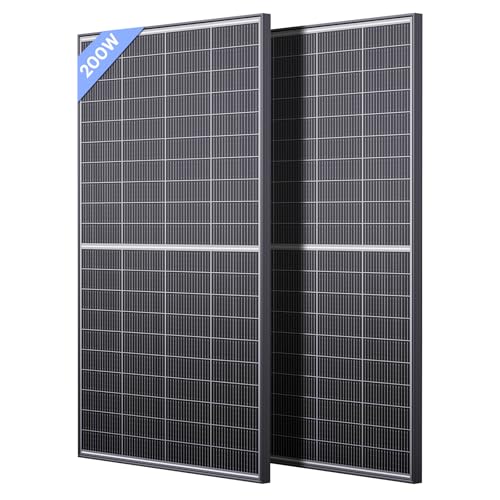
The N-Type 16BB 400W Bifacial Solar Panel kit packages two matched 200-watt modules engineered to supply substantial off-grid energy in a footprint tailored for mobile installations. Built with 60 advanced N-type monocrystalline silicon cells per module, the setup reaches an impressive 25.6% conversion efficiency. The integration of 16 micro-busbars across each wafer reduces the path length for electrical current, cutting down internal resistance losses and significantly curbing the formation of microcracks and localized hot spots over long service cycles. This dense grid design ensures consistent, reliable electron flow even when mounted on vehicles subjected to relentless road vibrations.
One of the strongest technical advantages of this two-panel setup is its electrical versatility. When connected in series, the two panels generate a combined 400W output with an operating voltage (Vmp) of 47.48V and an open-circuit voltage (Voc) of 54.62V while holding an operating current of 8.43A. This high-voltage, moderate-current profile is engineered to match portable power stations equipped with 60V-class solar charging inputs, maximizing input wattage without exceeding common amperage thresholds. Furthermore, each module incorporates a TwinCell dual-module parallel architecture that splits the physical panel into two independently operating halves. When roadside branches, roof vents, or air conditioners shade the top half of the panel, the lower half continues to produce power at full efficiency rather than shutting down the entire circuit.
Outdoor durability is reinforced through 3.2mm tempered front glass, an anodized aluminum alloy frame, and an IP68-rated weatherproof junction box with pre-attached solar connectors. With a low temperature coefficient of -0.30%/K, these callsun n-type solar panels resist the steep power drop-offs that standard solar panels experience under direct summer heat. A transparent backsheet allows ambient, diffuse, and surface-reflected light to reach the underside of the cells, creating supplemental energy gain on light-colored vehicle roofs or ground racks. For family overland builds requiring detailed layout flexibility, reviewing our comprehensive callsun 200w solar panel overview can provide additional context on mounting multiple medium-format modules.
420W(2x210W) N-Type 16BB Bifacial Solar Panel,VmpBest for Higher-Voltage Solar Banks

Buyer favourite4.7 or better on Amazon’s buyer average
Price not listed
4.8Amazon buyer averageOverwhelmingly positive
Brand Callsun ASIN B0H2HHC6SR
Best for: High-voltage battery banks and camper conversions
Pros
- High 34.2V operating voltage per panel
- Quarter-cut cells minimize microcracking
- Up to 30% bifacial energy gain
Cons
- Longer 54.2-inch physical profile
- Lower 6.1A operating current
Designed for demanding electrical systems, the 420W(2x210W) N-Type 16BB Bifacial Solar Panel,Vmp kit features two high-voltage modules delivering 210 watts apiece. Each panel operates at a native working voltage (Vmp) of 34.2V and an open-circuit voltage of 40.3V, running at an operating current of 6.1A. By providing such high native voltage straight from an individual module, this configuration allows users to efficiently charge 12V, 24V, 36V, or 48V battery systems using a standard MPPT controller without necessitating long, complex series wiring runs that risk high voltage penalties in shaded situations.
At the cell level, this callsun bifacial solar panel kit uses Grade A+ quarter-cut N-type monocrystalline silicon cells matched with 16BB busbars. Quarter-cut cell technology cuts internal resistive current in half compared to full-size cells, minimizing heat generation within the panel laminate and providing exceptional protection against structural microcracking caused by highway travel. The panel also employs the brand’s dual-module parallel anti-shade design, ensuring that a shadow falling across one hemisphere of the panel leaves the unshaded half operating without interruption. With its transparent rear backsheet, the module can capture ambient ground reflection from snow, pale sand, or concrete surfaces to supply an additional bifacial energy boost of up to 30% under favorable conditions.
Physically, each 210W panel measures 54.2 by 30.2 inches with a 1.4-inch frame profile and weighs 24.9 pounds. The assembly is built to withstand operating temperatures up to 85 degrees Celsius and features heavy 3.2mm tempered glass seated inside an anodized aluminum frame. This kit caters directly to larger RV builds, fifth wheels, and off-grid cabin installations that run 24V or 48V battery banks and require maximum voltage headroom to ensure MPPT charge controllers wake up early in the morning and produce steady power through late afternoon.
N-Type 16BB 200 Watt Solar PanelBest for Compact Rooftop Layouts

Price not listed
4.6Amazon buyer averageVery positive
Brand Callsun ASIN B0DJP7T73D
Best for: Compact campervans with congested roof space
Pros
- Compact footprint navigates roof obstructions
- Lightweight 11.4-pound individual panel weight
- Heavy-duty 5400 Pa snow load rating
Cons
- Non-bifacial solid rear construction
- Lower individual 100W module capacity
The N-Type 16BB 200 Watt Solar Panel package takes a modular, space-saving approach by bundling two distinct 100-watt panels (model Callsun-DB100W). Measuring 31.1 by 22.7 inches with a slim 1.1-inch profile and weighing only 11.4 pounds per panel, these units are approximately 15% more compact than traditional 100-watt modules while achieving up to 25% cell conversion efficiency. Their small individual footprint makes them an exceptional choice for campervans, truck toppers, teardrop trailers, and marine vessels where large continuous stretches of open roof do not exist.
Rather than using a transparent rear surface, this 200W kit uses a traditional solid, opaque backsheet, making it well-suited for flush-mount vehicle brackets where underneath airflow is minimal and reflected rear light is virtually non-existent. Each panel operates at a nominal 12V output, allowing seamless integration into 12V and 24V systems. The high-density 16BB cell architecture ensures reliable current distribution and limits microcrack degradation, while four pre-drilled mounting holes along the aluminum frame simplify bracket alignment around roof vents, skylights, and rooftop air conditioning shrouds.
Despite their lightweight structure, these callsun rv solar panel units offer serious structural resilience. They are constructed with 3.2mm low-iron tempered glass, corrosion-resistant aluminum frames with reinforced corner guards, and an IP68-rated waterproof junction box. The panels carry mechanical load certifications capable of resisting 2400 Pa wind pressures and up to 5400 Pa heavy snow loads. Their low temperature coefficient of -0.3%/°C keeps thermal losses minimal during midsummer desert travel. For campers seeking an even deeper look at fitting smaller modules, our detailed guide on the callsun 100w solar panel offers helpful placement suggestions.
N-Type 16BB 200W Bifacial Solar PanelBest for Streamlined Single-Panel Builds
Price not listed
4.6Amazon buyer averageVery positive
Brand Callsun ASIN B0DRX3MYBR
Best for: Solo Class B van installations
Pros
- Single 200W module simplifies wiring
- High 25.6% conversion efficiency
- Bifacial design captures rear reflected light
Cons
- Single panel caps output at 200W
- Requires 51.3-inch continuous mounting span
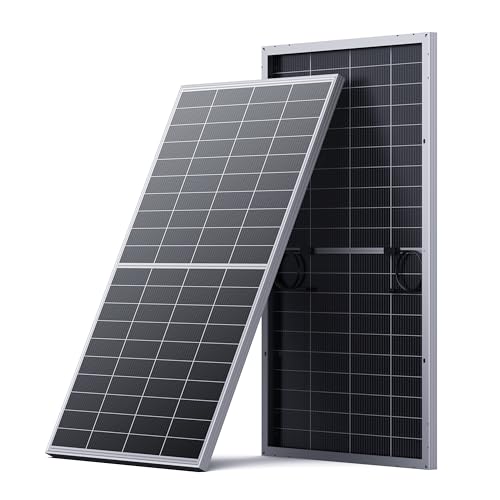
For campervan builders who want simplicity without sacrificing advanced photovoltaic engineering, the N-Type 16BB 200W Bifacial Solar Panel provides a single-module solution that delivers 200 watts of rated capacity. Sized at 51.3 by 30.3 by 1.4 inches and weighing 23.8 pounds, this single panel avoids the complexity of external branch connectors, parallel combiner splitters, or extra cabling runs across the vehicle roof. It delivers an operating voltage (Vmp) of 23.74V and an operating current of 8.43A, making it easy to integrate into both 12V and 24V off-grid power systems.
The panel features N-type monocrystalline silicon cells paired with 16BB busbars to attain an outstanding 25.6% conversion efficiency. Integrated TwinCell anti-shade technology divides the module into two parallel sections, maintaining up to 50% of the panel’s active output if an overhead tree branch or rooftop cargo box casts a shadow over one half. In addition, the panel uses a transparent backsheet to unlock bifacial energy generation, yielding up to an extra 30% of power by harvesting ambient and reflected light bouncing off pale roofs, white gelcoats, light gravel, or winter snow.
The physical structure is engineered for long-term outdoor endurance, featuring 3.2mm fully tempered glass, an anodized aluminum frame, and an IP68 junction box with pre-installed solar connectors. Its structural design is rated to endure 2400 Pa wind uplift forces and 5400 Pa snow loads, while the low -0.3%/°C temperature coefficient prevents steep midday voltage drops in hot climates. This single-panel option suits solo adventurers and Class B campervan owners who want a straightforward, plug-and-play installation that maximizes power density from a single mounting zone.
How to Choose the Right Callsun Solar Panels
Selecting the ideal Callsun solar array requires balancing roof surface availability, electrical system voltage, and whether your mounting configuration allows the rear side of the panel to absorb reflected light. While every model in this callsun solar panels comparison features high-efficiency N-type silicon and rugged 16BB engineering, their physical sizes and electrical characteristics serve distinct operational roles.
If you are outfitting a compact campervan or a vehicle roof interrupted by exhaust fans, luggage carriers, and antennas, the dual-panel N-Type 16BB 200 Watt Solar Panel kit is the easiest to arrange. Because it splits the 200-watt total into two small 11.4-pound panels, you can position each module on opposite sides of a rooftop vent or roof rack. However, because these panels feature an opaque backsheet, they do not harvest rear-side reflected sunlight and are best mounted flat against the vehicle surface.
When you have a continuous rectangular space on a van roof or ground array, choosing between the 400W bifacial kit, the 420W high-voltage kit, and the single 200W bifacial panel comes down to electrical matching. The single N-Type 16BB 200W Bifacial Solar Panel keeps wiring minimal on Class B vans while retaining anti-shade protection and bifacial harvesting. Conversely, if you need 400 watts or more to support induction cooking, portable refrigeration, and laptops, the dual 200W kit offers an ideal series voltage profile for 60V-class portable power stations.
For systems utilizing 24V or 48V stationary battery banks, the 420W(2x210W) N-Type 16BB Bifacial Solar Panel,Vmp stands out due to its high native operating voltage of 34.2V per panel. This elevated voltage reduces wire gauge requirements, ensures your MPPT charge controller operates in its most efficient conversion band, and maintains high charging rates even during overcast days when system voltages tend to sag.
Finally, evaluate your mounting surface. To take full advantage of Callsun’s bifacial models, elevate the panels several inches above light-colored RV roofs, white paint, or reflective ground surfaces. If your mounting system requires a completely flush mount that sits flat against a dark surface, a standard opaque panel or a bifacial panel operating strictly on front-side light will function reliably, but you will not realize the extra rear-gain yield.
FAQ
What is the difference between N-type cells and traditional P-type solar panels?
Callsun n-type solar panels use silicon doped with phosphorus rather than the boron doping found in conventional P-type panels. This chemical difference eliminates light-induced degradation (LID) during the first hours of sun exposure, resulting in higher overall efficiency ratings of up to 25.6% and longer power retention over decades of use. N-type silicon also exhibits a lower temperature coefficient, meaning the panels produce more usable watt-hours in high-temperature environments.
Why does Callsun use 16BB busbar engineering in their solar panels?
The 16BB (16-busbar) layout uses sixteen ultra-thin conductive ribbons across each cell instead of the traditional nine or ten busbars. This design shortens the distance that generated electricity must travel across the cell surface, reducing internal electrical resistance and heat buildup. It also creates multiple redundant paths for current flow, ensuring that if road vibrations cause a microcrack in the silicon, power continues to flow around the fracture without causing hot spots or significant performance loss.
How does the TwinCell dual-module anti-shading technology work?
Conventional solar panels wire all cells in a continuous series string, meaning a shadow cast over just a few cells can throttle the entire panel’s output. Callsun’s TwinCell parallel design splits the module into two independent halves connected in parallel. If an overhead obstruction or vehicle vent shades one half, the unshaded half continues generating energy at full capacity, preserving up to 50% or more of the panel’s total output under partial shading conditions.
Can a Callsun bifacial solar panel produce extra power on an RV roof?
Yes, a callsun bifacial solar panel can produce supplemental power on an RV roof, provided there is adequate elevation between the panel’s transparent backsheet and the roof surface. When mounted using raised Z-brackets over white or light-colored RV roofing material, reflected and diffuse sunlight reaches the rear of the cells, boosting total energy production by up to 10% to 30% depending on sun angle, elevation height, and roof reflectivity.
What type of solar charge controller should be used with Callsun 16BB solar panels?
An MPPT (Maximum Power Point Tracking) charge controller is strongly recommended for all Callsun panels, especially the high-voltage 34.2V Vmp models and modules wired in series. MPPT controllers actively track the panel’s optimal voltage and step it down to your battery bank’s charging voltage with minimal power loss, capturing significantly more daily amp-hours than basic PWM controllers.
- Ryobi 1800W Power Station Comparison: Reliable Household Power Solutions 4.3Amazon buyer avg
- Anker 24,000mAh Class Power Banks: Heavy-Duty Portable Chargers Compared 4.5Amazon buyer avg
- ALLWEI Portable Power Station Guide: 300W Models and Family Backup Picks 4.2Amazon buyer avg
- Westinghouse Tri-Fuel Generators: Complete Home Backup Comparison 4.4Amazon buyer avg
- Hessaire Swamp Coolers Compared: Choosing the Best Model for Your Space 4.0Amazon buyer avg
- EcoFlow Battery Packs: Comparing Standalone Power & Expansion Options 4.4Amazon buyer avg