Goal Zero Solar Panel Guide: Comparing Nomad and Boulder Series for Families
As Amazon Associates, we earn from qualifying purchases. This means we may receive a small commission at no extra cost to you if you click through and make a purchase.
Goal Zero has established a solid reputation among campers, outdoor enthusiasts, and preparedness-minded families for reliable, clean power hardware. When building an off-grid charging setup, finding the right goal zero solar panel means balancing physical durability against overall packability. The brand engineered its solar collection around two distinct philosophies: the rigid, heavy-duty Boulder line designed for stationary setups and vehicle camping, and the foldable, lightweight Nomad line tailored for active trail use and compact transport.
While the Boulder series relies on tempered glass and anodized aluminum frames to endure prolonged exposure to weather, the Nomad series emphasizes collapsible monocrystalline designs with rugged fabric or composite casings, meaning each line addresses completely different packing constraints, weights, and energy demands.
Product rundown
6 models are covered below. Pick a row to jump straight to it.
| No. | Model | Price |
|---|---|---|
| 01 |
 Goal Zero Boulder 200 BriefcaseBest for Basecamp Power Goal Zero Boulder 200 BriefcaseBest for Basecamp Power |
Price not listed |
| 02 |
 Goal Zero Nomad 10Best for Hiking Packs Goal Zero Nomad 10Best for Hiking Packs |
Price not listed |
| 03 |
 Goal Zero Nomad 100 Watt MonocrystallineBest for Mobile Campsites Goal Zero Nomad 100 Watt MonocrystallineBest for Mobile Campsites |
Price not listed |
| 04 |
 Goal Zero Boulder 100 BriefcaseBest for All-Weather Cabin Living Goal Zero Boulder 100 BriefcaseBest for All-Weather Cabin Living |
Price not listed |
| 05 |
 Goal Zero Nomad 20Best for Portable Bank Charging Goal Zero Nomad 20Best for Portable Bank Charging |
Price not listed |
| 06 |
 Goal Zero Nomad 5 Solar PanelBest for Ultralight Essentials Goal Zero Nomad 5 Solar PanelBest for Ultralight Essentials |
Price not listed |
Goal Zero Solar Panels Compared
| Model | Rated Wattage | Weight | Build Material | Output Connectors |
|---|---|---|---|---|
| Goal Zero Boulder 200 Briefcase | 200 watts (two 100W panels) | 42 pounds | Tempered glass and aluminum frame | USB |
| Goal Zero Nomad 10 | 10 watts | 1.2 pounds (510 g) | Plastic laminate enclosure | USB |
| Goal Zero Nomad 100 Watt Monocrystalline | 100 watts | 12 pounds | Monocrystalline silicon and fabric | 8mm Goal Zero and MC4 |
| Goal Zero Boulder 100 Briefcase | 100 watts (two 50W panels) | 25.9 pounds | Tempered glass and anodized aluminum | USB |
| Goal Zero Nomad 20 | 20 watts | 2.3 pounds | Plastic laminate enclosure | 8mm and USB |
| Goal Zero Nomad 5 Solar Panel | 5 watts | 360 grams | ABS resin enclosure | USB |
Goal Zero Boulder 200 BriefcaseBest for Basecamp Power

Buyer favourite4.7 or better on Amazon’s buyer average
Price not listed
4.7Amazon buyer averageOverwhelmingly positive
Brand Goal Zero ASIN B0753TW31T

Best for: All-weather car camping and emergency backup
Pros
- Rigid anodized aluminum frame
- Tempered glass weather resistance
- Built-in deployable kickstand
- Protective corner bumpers
Cons
- Weighs nearly 26 pounds
- Rigid briefcase takes cargo space
Best for: Basecamp setups and long-term off-grid RV travel
Pros
- 200-watt combined output
- Rugged tempered glass and aluminum frame
- Built-in kickstands with stake loops
- Protective canvas storage bag included
Cons
- Heaviest panel at 42 pounds
- Bulky footprint for transport
The Goal Zero Boulder 200 Briefcase serves as the heavyweight flagship in the brand’s rigid portable category. Built using two hinged 100-watt monocrystalline panels enclosed in an anodized aluminum frame, this unit is engineered for substantial power harvesting. It features heavy-duty corner protection to guard against impact during transit and regular campsite deployment. At 42 pounds and measuring 40 by 26.75 by 3.5 inches when closed, it is built specifically for users operating from vehicles, basecamps, or remote cabins where carrying mass is secondary to energy yield.
Stability and positioning are handled by built-in legs that fold out to angle the surface directly toward incoming sunlight. Each leg includes an integrated stake-down loop to anchor the heavy assembly against wind gusts. The unit delivers a listed 21 percent cell efficiency and a maximum voltage rating of 120 volts. For family camping scenarios involving a minifridge, laptops, lighting, and communication devices, pairing this panel with a compatible yeti power generator provides dependable, zero-emission charging without generator noise. The manufacturer packages the unit with a protective canvas bag to shield the tempered glass during vehicle transport.
For family groups embarking on extended overland travel, van life, or off-grid camping trips, the goal zero boulder 200 briefcase provides the highest output among the brand’s briefcase models. However, its substantial 42-pound weight means it requires a dedicated cargo area and is unsuited for foot travel. Campers who prioritize quick, solo physical packing might look toward the lighter briefcase or fabric alternatives.
Goal Zero Nomad 10Best for Hiking Packs
Buyer favourite4.7 or better on Amazon’s buyer average
Price not listed
4.7Amazon buyer averageOverwhelmingly positive
Brand Goal Zero ASIN B085KVK22P
Best for: Minimalist hikers charging phones and headlamps
Pros
- Ultra-lightweight at 360 grams
- Rugged ABS resin protective shell
- Built-in kickstand for quick angle adjustments
- Direct USB-A port charging
Cons
- 5-watt output charges slowly
- No larger 8mm power station output
Best for: Weekend backpackers charging small power banks
Pros
- Dual outputs with USB and 8mm
- Built-in Flip power bank dock
- Lightweight 2.3-pound foldable design
- Integrated cable storage compartment
Cons
- Limited to 20-watt max output
- Plastic casing rather than aluminum

Best for: Family campers needing portable high-wattage power
Pros
- 100-watt output in folding form
- Weighs only 12 pounds
- Integrated 8mm connector for Yeti stations
- Chainable with optional combiner cable
Cons
- Lacks built-in kickstand legs
- Fabric exterior requires clean surfaces
Best for: Day hikers wanting compact USB trail charging
Pros
- Weighs only 1.2 pounds
- Adjustable 180-degree kickstand
- Direct USB device charging
- Compact foldable footprint
Cons
- Modest 10-watt output
- Single USB port only
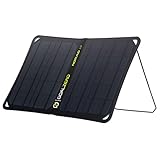
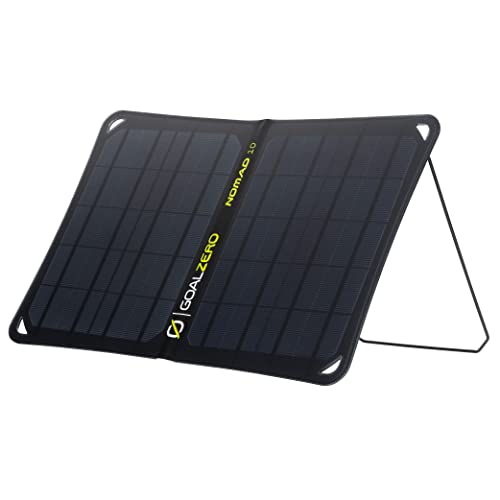
The Goal Zero Nomad 10 targets travelers, backpackers, and family day-trippers seeking steady power without excessive packing weight. Delivering 10 watts of monocrystalline output at a maximum of 6 volts, this compact panel incorporates an integrated USB port engineered specifically for small electronics such as handheld GPS devices, smartphones, lanterns, and portable radios. Weighing just 1.2 pounds (510 grams), it measures 9.5 by 14.5 by 0.75 inches unfolded and condenses to 9.5 by 7.2 by 1.3 inches when folded closed.
Mounting versatility is one of the standout aspects of the goal zero nomad 10. The perimeter features attachment points designed to lash securely to outdoor hiking packs, allowing users to collect sunlight while moving along trail routes. When stationed at a picnic bench or tent site, a built-in 180-degree adjustable kickstand lets you dial in the surface angle toward the sun across different times of day. Developed by a US-based engineering team with decades of solar experience, the durable plastic composite exterior provides resistance against standard outdoor handling, backed by a 1-year manufacturer warranty.
This model is ideal for solo hikers, scouts, or parents who need a reliable, packable charger for essential electronics on daytime outings. Because the 10-watt output is restricted to direct USB charging, it does not support high-draw camp appliances or full-sized storage stations. Hikers who require multi-voltage support or faster recharge cycles will find those capabilities in the larger Nomad tiers.
Goal Zero Nomad 100 Watt MonocrystallineBest for Mobile Campsites

Buyer favourite4.7 or better on Amazon’s buyer average
Price not listed
4.8Amazon buyer averageOverwhelmingly positive
Brand Goal Zero ASIN B016UQNGFS
The Goal Zero Nomad 100 Watt Monocrystalline delivers high-output generation in a soft-sided, foldable architecture. Designed as the largest folding solar panel in the manufacturer’s lineup, it provides 100 watts of power across an 18 to 22-volt operating range. It measures 20.5 by 20.5 by 2 inches unfolded and collapses down into a compact 20 by 15 by 2-inch format. Despite its considerable surface area, the unit weighs only 12 pounds, making it less than half the weight of rigid glass briefcase units with equivalent wattage ratings.
Connectivity is centered around an integrated 8mm Goal Zero cable designed for plug-and-play operation with compatible battery units, alongside listed MC4 connectors. When paired with an off-grid goal zero power station, it delivers rapid charging for field operations, remote family camps, or emergency residential preparedness. For users requiring additional input, the goal zero nomad 100 is chainable with additional panels using an optional 8mm-to-APP combiner cable. The monocrystalline silicon cells are laminated into a rugged, weatherproof fabric frame that handles moisture and outdoor dust during multi-day excursions.
Active outdoor families who want high-capacity charging without sacrificing valuable trunk space will appreciate the packability of this unit. Unlike the rigid Boulder frames, it lacks hard metal kickstands, meaning users must lean it against camp furniture, vehicles, or gear bags to catch the optimal solar angle. For campers who manage gear in tight vehicles, its low weight makes it a compelling alternative to glass briefcases.
Goal Zero Boulder 100 BriefcaseBest for All-Weather Cabin Living

Buyer favourite4.7 or better on Amazon’s buyer average
Price not listed
4.9Amazon buyer averageOverwhelmingly positive
Brand Goal Zero ASIN B06Y3TC113
The Goal Zero Boulder 100 Briefcase merges permanent-grade materials with portable briefcase utility. Composed of two 50-watt monocrystalline solar panels joined by a central hinge, this unit provides 100 watts of total generation. It is constructed with an anodized aluminum frame, reinforced corner guards, and tempered glass paneling. This rigid build provides exceptional weatherproofing against driving rain, blowing sand, and prolonged UV exposure, backed by a 2-year manufacturer warranty.
Weighing 25.9 pounds and measuring 40 by 26.75 by 1.75 inches when open, the goal zero boulder 100 briefcase offers stability on uneven ground. It features a built-in kickstand that props the panel assembly at an angle, eliminating the need to search for support props around camp. The listing specifies USB connectivity alongside its charging cord, allowing integration into standard outdoor battery banks and field gear. The tempered glass and metal frame offer rigid durability that resists cell flexing or abrasion over years of hard use.
This briefcase model is perfectly matched for family car camping, seasonal hunting camps, and emergency power kits stored in the garage. Its 25.9-pound weight requires deliberate two-handed lifting, meaning it is strictly designed for vehicle transport rather than long-distance foot carry. For users operating primarily out of a truck bed or stationary campsite, its structural strength provides lasting peace of mind.
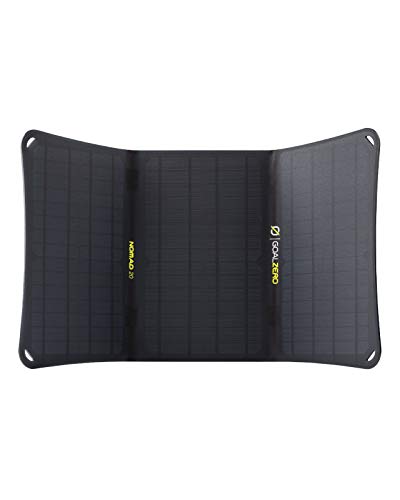
Goal Zero Nomad 20Best for Portable Bank Charging
Price not listed
4.2Amazon buyer averageMostly positive
Brand Goal Zero ASIN B085KYN2WY
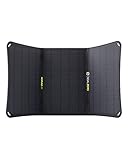
The Goal Zero Nomad 20 bridges the divide between ultra-compact pocket panels and large campsite foldables. Supplying 20 watts of power across an 18 to 22-volt profile, this monocrystalline folding charger weighs 2.3 pounds. Unfolded, it spans 30.51 by 12.99 by 0.98 inches, while closing down into an 11.5 by 7.4 by 1.25-inch footprint that slides easily into a family daypack, duffel bag, or emergency supply tub.
The panel features dual connection paths: an integrated 8mm charging cable for mid-sized storage units and a standard USB port for direct small electronics charging. The rear housing includes an integrated cable storage pouch, keeping cords organized and untangled during transit. It also incorporates a specialized dock designed to hold compatible power banks securely while they recharge. The 180-degree adjustable kickstand allows precise alignment with morning or late-afternoon sun angles, while corner lash points allow attachment to tents or daypacks.
Campers who want the flexibility to recharge both handheld USB devices and compact battery generators will find the goal zero nomad 20 well balanced for short weekend trips. While it delivers double the output of the Nomad 10, it cannot replenish high-capacity basecamp power stations in a single afternoon. It gives way to the Nomad 100 when high wattage is necessary for running coolers or heavy equipment.
Goal Zero Nomad 5 Solar PanelBest for Ultralight Essentials

Buyer favourite4.7 or better on Amazon’s buyer average
Price not listed
4.7Amazon buyer averageOverwhelmingly positive
Brand Goal Zero ASIN B07TJ3J578
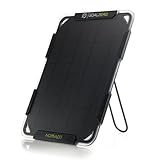
The Goal Zero Nomad 5 Solar Panel stands as the most compact, stripped-down charging solution in the brand’s catalog. Producing 5 watts of monocrystalline power with a 1-amp capacity, this single-panel charger weighs just 360 grams. Its rigid ABS resin enclosure measures 9.45 by 7.01 by 1.1 inches, making it roughly the size of a paperback notebook. The rugged exterior is engineered to survive drops, gear-bin jostling, and unpredictable weather on the trail.
Designed for basic, dependable power generation, the goal zero nomad 5 includes a rear-mounted adjustable kickstand that clicks into multiple angles to capture direct sunlight. The integrated USB-A port allows users to plug mobile phones, headlamps, GPS units, lanterns, and fitness trackers straight into the panel. It is also designed to clip directly to compact power banks, letting family members collect power throughout daytime hikes to use around the campfire after dark.
For minimalist backpackers, emergency kit builders, and parents packing an ultralight emergency charger for park visits, the Nomad 5 delivers straightforward function. Its 5-watt rating means charging larger smartphones or power banks takes noticeable time and requires direct, uninterrupted sunlight. Shoppers seeking multi-device charging or cloudy-day headroom will be better served stepping up to the Nomad 10 or 20.
How to Choose the Right Goal Zero Solar Panel
Selecting the best goal zero solar panel requires balancing power requirements, transport methods, and setup environments. A comprehensive goal zero solar panel comparison starts with understanding the structural differences highlighted in the goal zero boulder vs nomad debate. Boulder panels are built using rigid anodized aluminum frames and heavy tempered glass surfaces, making them exceptional for wind resistance, long-term campsite setups, and weather resilience. In contrast, Nomad panels use laminated monocrystalline materials encased in fabric or ABS resin, prioritizing low packing volume and minimal trail weight.
When determining which goal zero solar panel to buy, evaluate your primary energy storage equipment and daily power draw. Small 5-watt to 20-watt panels excel at keeping personal devices, headlamps, and handheld power banks operational on hikes or weekend family outings. If your primary goal is maintaining campsite refrigeration, camp lighting, or emergency medical gear, higher-wattage units like the 100-watt and 200-watt models are necessary to replenish multi-hundred-watt-hour batteries within daylight windows.
Transport logistics play an equally vital role in your final choice. At 42 pounds, the Boulder 200 Briefcase is best suited for trucks, RVs, and dedicated overland trailers. If physical storage space inside your trunk is limited, the fabric-based Nomad 100 offers equivalent 100-watt charging performance at just 12 pounds, though it requires gentle handling on abrasive surfaces. For mobile off-grid campers interested in alternative flexible technology, comparing formats with a dokio flexible solar panel can provide additional perspective on panel weight and surface flexibility.
Cable connectivity and system compatibility should finalize your selection. While smaller Nomad panels feature direct USB ports for plug-and-play phone charging, larger units use 8mm barrel connectors or MC4 couplings designed for power station inputs. Verify whether your power bank requires direct USB, 12-volt, or proprietary connectors before selecting your panel, ensuring that your field setup operates smoothly without third-party adapter bottlenecks.
FAQ
Can Goal Zero solar panels get wet in the rain?
Boulder series panels feature tempered glass, anodized aluminum frames, and sealed junction enclosures that provide weatherproofing against rain and outdoor exposure. The Nomad line uses rugged laminate and water-resistant fabric construction designed to withstand trail conditions, though the integrated USB ports and cable storage pockets should be shielded from soaking water to prevent corrosion or electrical faults.
What is the main difference in the Goal Zero Boulder vs Nomad design?
The primary difference lies in structural construction and weight. Boulder models feature rigid aluminum frames, corner guards, and tempered glass faces, making them durable and stationary but heavy. Nomad models feature foldable fabric or composite enclosures designed for ultralight portability, fitting inside backpacks or small luggage compartments.
Do Goal Zero solar panels store electrical power internally?
Goal Zero solar panels do not store electrical energy on their own. They convert solar radiation into direct electrical output, requiring either direct connection to a small electronic device via USB or connection to an external power bank or Yeti battery station to store energy for nighttime use.
Can you link multiple Goal Zero solar panels together?
Yes, select larger panels in the lineup, such as the Nomad 100, are chainable. Connecting multiple panels allows users to combine total wattage to speed up battery recharge times, provided you use the appropriate 8mm or high-power combiner cables designed for the system.
How do the built-in kickstands improve charging efficiency?
Positioning a solar panel perpendicular to the sun’s rays maximizes sunlight absorption and energy conversion. Both Boulder and Nomad models include built-in adjustable kickstands, allowing users to alter panel angles throughout the day as the sun shifts across the sky, avoiding flat ground placement that reduces charging output.
- Ryobi 1800W Power Station Comparison: Reliable Household Power Solutions 4.3Amazon buyer avg
- Anker 24,000mAh Class Power Banks: Heavy-Duty Portable Chargers Compared 4.5Amazon buyer avg
- ALLWEI Portable Power Station Guide: 300W Models and Family Backup Picks 4.2Amazon buyer avg
- Westinghouse Tri-Fuel Generators: Complete Home Backup Comparison 4.4Amazon buyer avg
- Hessaire Swamp Coolers Compared: Choosing the Best Model for Your Space 4.0Amazon buyer avg
- EcoFlow Battery Packs: Comparing Standalone Power & Expansion Options 4.4Amazon buyer avg